UK Home Renovation Trends & Statistics 2026

The UK home improvement market was valued at $15 billion (~£11.3 billion) as of 2025 and is projected to reach $21.8 billion (~£16.4 billion) by 2034 – an expected rise of almost half (+45.3%) in nine years. With almost seven million UK homeowners intending to renovate their houses by 2027, at an average of £14,000 per project, this pattern of growth looks set to continue for years to come.
With this in mind, Hillarys has compiled the latest UK home renovation trends and statistics for 2026 to show how the UK home improvement market has evolved and what the future may hold for those undertaking property refurbishment projects up and down the country.
The average cost of renovating a house in the UK will depend on many factors, including:
The following sections outline some typical house renovation costs in the UK. However, the best way to get accurate home renovation prices is to get quotes from local tradespeople and compare the outcomes to find the person who is right for you and your budget.
When it comes to refurbishing your home, there are some typical renovation costs you could incur. But these will depend on what work you plan on doing and the extent of the home improvement project.
For example, the average loft conversion cost is around £45,000 (potentially one of the most expensive home renovation projects). By comparison, the average cost of a house extension could fall anywhere between £26,000 and £34,000, depending on the type of extension and how much work you plan to do.
| Project | Typical house renovation cost |
|---|---|
| Loft conversion (20m) | £27,500 – £75,000+ (average dormer £50,000) |
| Extension | £40,000 – £60,000 |
| Damp | Up to £16,000 |
| New roof | £4,500 - £12,000 |
| New kitchen | £10,000+ |
| Garage conversion | £8,500–£20,000 (average £14,250) |
| Subsidence | £6,000 |
| New bathroom | £6,000 |
| Installing central heating | £4,000 |
| New boiler | £2,700 |
| Fixing rot | £1,000 - £2,000 |
| Woodworm treatment | £450 - £800 |
| Double glazing | £400 - £600 per window |
Source: Information from HomeOwners Alliance’s article UK house renovation costs, Typical house renovation costs
You may find that some renovation projects don’t become an issue. However, should you need to repair damage caused by dampness (for example), the average cost of damp proofing could reach anything up to £16,000. Similarly, a new roof could cost between £4,500 and £12,000, depending on the extent of the damage and how much work needs to be done.
At the other end of the scale, some home improvements may be relatively cheaper to complete than others. For example, the average woodworm treatment cost usually falls between £450 and £800, with the price to fix rot typically somewhere between £1,000 and £2,000.
The cost of renovating a house in the UK depends on the property’s size, location and the extent of the work required.
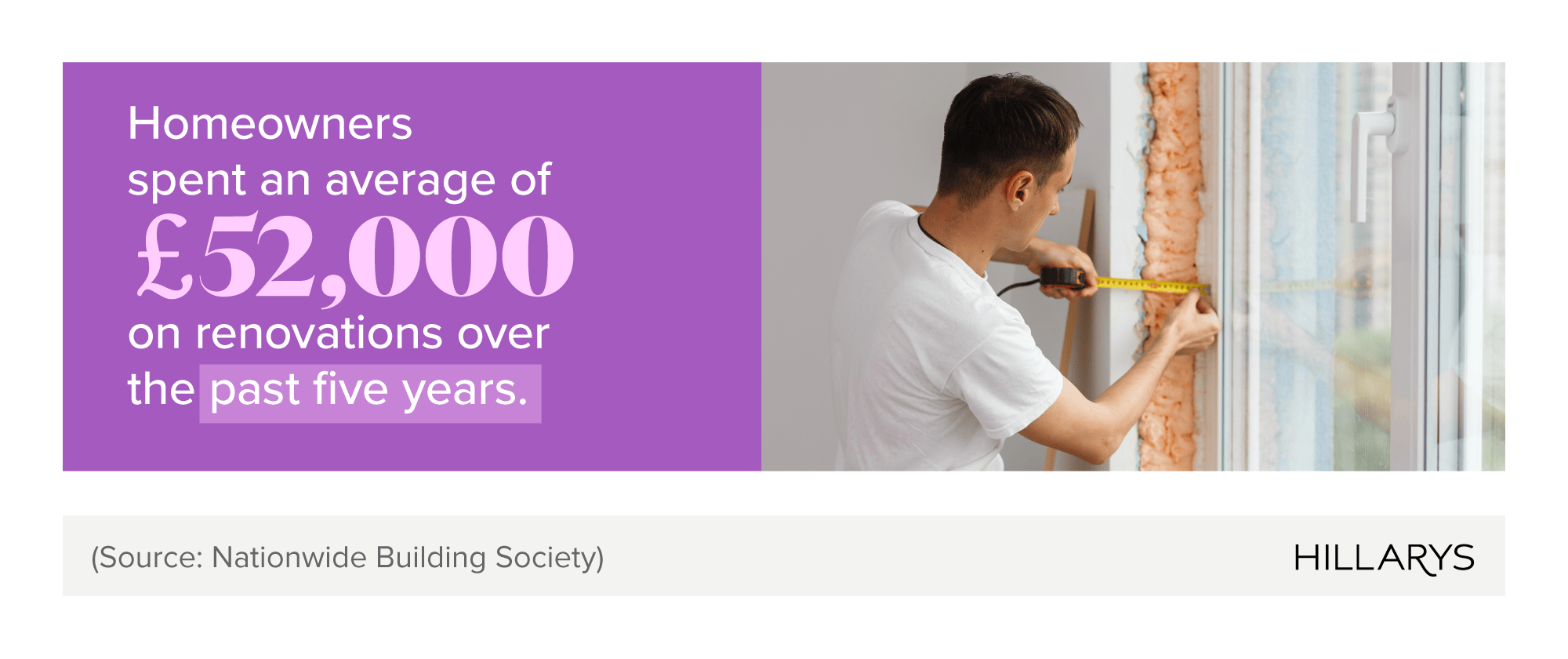
According to Nationwide Building Society, UK homeowners spent an average of £52,000 on renovations over the past five years.
As a general guide, a full house refurbishment cost is typically estimated at 15%-30% of the property’s value after renovation, rising towards the upper end for homes requiring a complete overhaul.
There is no single average cost of renovating a 2-bed house, as the final price depends on its condition, location, and the standard of finish.
| Renovation Stage | Estimated Cost |
|---|---|
| Strip-out and waste removal | £1,260–£2,450 |
| Roof repairs or replacement | £3,000–£7,500 |
| Electrical (first fix) | £2,000–£4,000 |
| Plumbing (first fix) | £2,000–£4,000 |
| Heating (first fix) | £2,000–£5,000 |
| Insulation | £1,500–£7,500 |
| Plastering | £3,000–£7,000 |
| Flooring | £2,000–£5,000 |
| Decorating | £2,000–£4,000 |
Source: Information from Clifton Private Finance’s article House Renovation Costs in the UK: The 12-Stage Cost Breakdown
Of the renovation stages listed, roof repairs or replacement and insulation could be the most expensive, with costs reaching up to £7,500. Strip-out and waste removal is likely to be the cheapest, starting from around £1,260.
These figures are based on a small two-bedroom terraced house and should be treated as a guide, as not every property will require every type of work.
Based on estimates from Checkatrade, the average cost to renovate a home in the UK in 2026 was £76,690.
However, every house renovation is unique, so the typical price of renovating a house can vary massively. The average cost for a 3-bed house refurbishment will depend on the extent of the work required, the materials used and any complications encountered during the project.
In terms of individual home renovation projects, one of the most expensive is replastering the walls and ceilings, particularly if the existing material needs to be removed. Checkatrade estimates that hacking off the existing plaster and replastering the walls and ceilings costs an average of £26,500.
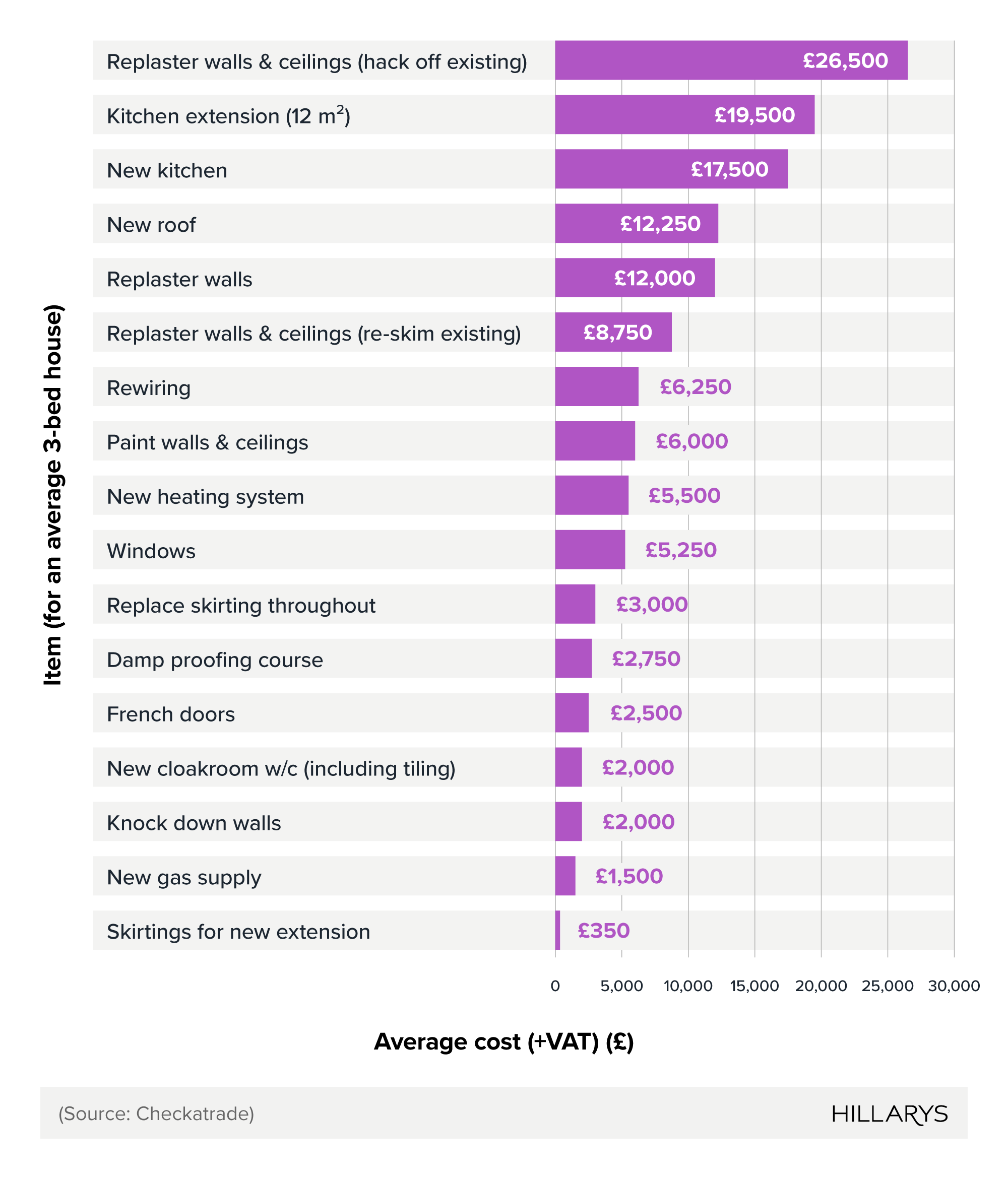
Similarly, the average cost of a 12m² kitchen extension for a 3-bed house in the UK is around £19,500, while a new kitchen costs an average of £17,500. However, the final sum will depend on various factors, such as the make, model, materials used, and the inclusion of any desired features in your new kitchen.
Adding skirting for a new extension is likely to be one of the lowest costs when renovating a 3-bed home, averaging around £350. This is followed by installing a new gas supply, which costs an average of £1,500.
Fitting a new downstairs cloakroom with tiling and knocking down walls could each cost around £2,000 for an average 3-bed house.
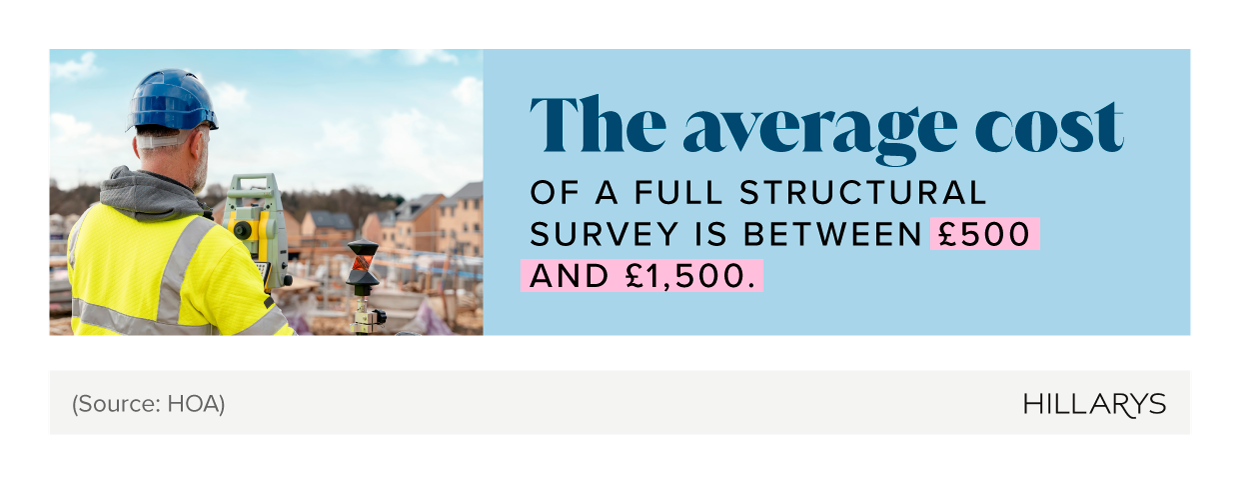
According to HomeOwners Alliance (HOA), the average cost of a full structural survey should be between £500 and £1,500. This is an important step in the UK home renovation process, as it will alert you to any problems with the property before undertaking any work and allow you to make informed decisions about where to best spend your money.
For example, if your home has been the victim of subsidence, you may need to underpin the property. This can cost anywhere up to £50,000. The Royal Institution of Chartered Surveyors estimate this is only necessary in less than 10% of cases, but it’s still something to bear in mind.
Realistically, the average cost of structural repairs is likely to be around £6,000. The average cost of a full structural survey will depend on many factors, such as the size, type, age, and location of your property.
Based on the property price at the time of purchase, you can expect to pay an average cost of:
A full structural survey is typically the most expensive option for those buying a property. However, there are other options available. For example, a condition report is a basic survey that gives a general overview of the property’s condition and draws attention to any large issues. This will likely cost around £250.
Similarly, a RICS Level 2 Home Survey (also known as a homebuyers report) goes into more detail than a condition report but is not as thorough as a full structural survey. Typically, this will set you back about £400.
Solid hardwood flooring is typically the most expensive. With an average hardwood flooring cost of £80+ per m², it makes it around 2.5 times more expensive than traditional softwood pine flooring and laminate. Incidentally, for 2026, the average laminate flooring installation cost in the UK was £30, making it one of the most affordable types of flooring to buy and install.
| Type of flooring | Average cost of materials (per m²) | Average cost of installation (per m²) |
|---|---|---|
| Solid hardwood | £80+ | £35 - £60 |
| Engineered wood | £50 | £45 |
| Luxury vinyl tile (LVT) | £35 | £45 |
| Softwood (pine) | £30 | £45 |
| Laminate | £30 | £30 |
Source: Information from Checkatrade’s guide How much does wooden flooring cost in 2026?
Conversely, the average cost of engineered wood flooring was £50 as of 2026, making it the second most expensive type of flooring to buy and install. The typical LVT flooring cost is just 35.3% less than engineered wood, yet both have similar average installation charges (£45 per m²).
| Additional item | Average cost |
|---|---|
| Floorboard replacement (labour + materials) | £45 per m² |
| Door trimming | £30 (per door) |
| Furniture relocation | £25-£30 per hour |
| Floor levelling (labour + screeding materials) | £6-£30 per m² |
| Skirting installation | £22 per m |
| Carpet removal and disposal | £7 per m² |
| Beading | £6.50 per m |
Source: Information from checkatrade's guide How much does wooden flooring cost in 2026?
Average flooring installation costs can vary depending on the type of flooring and the extent of the work in question.
At the higher end of the scale, floorboard replacement (labour and materials) typically costs around £45 per m², with the average cost of door trimmings approximately £30 per door.
Beading tends to be one of the cheaper items associated with installing new flooring, at an average of £6.50 per metre, followed by carpet removal and disposal (usually around £7 per m²).
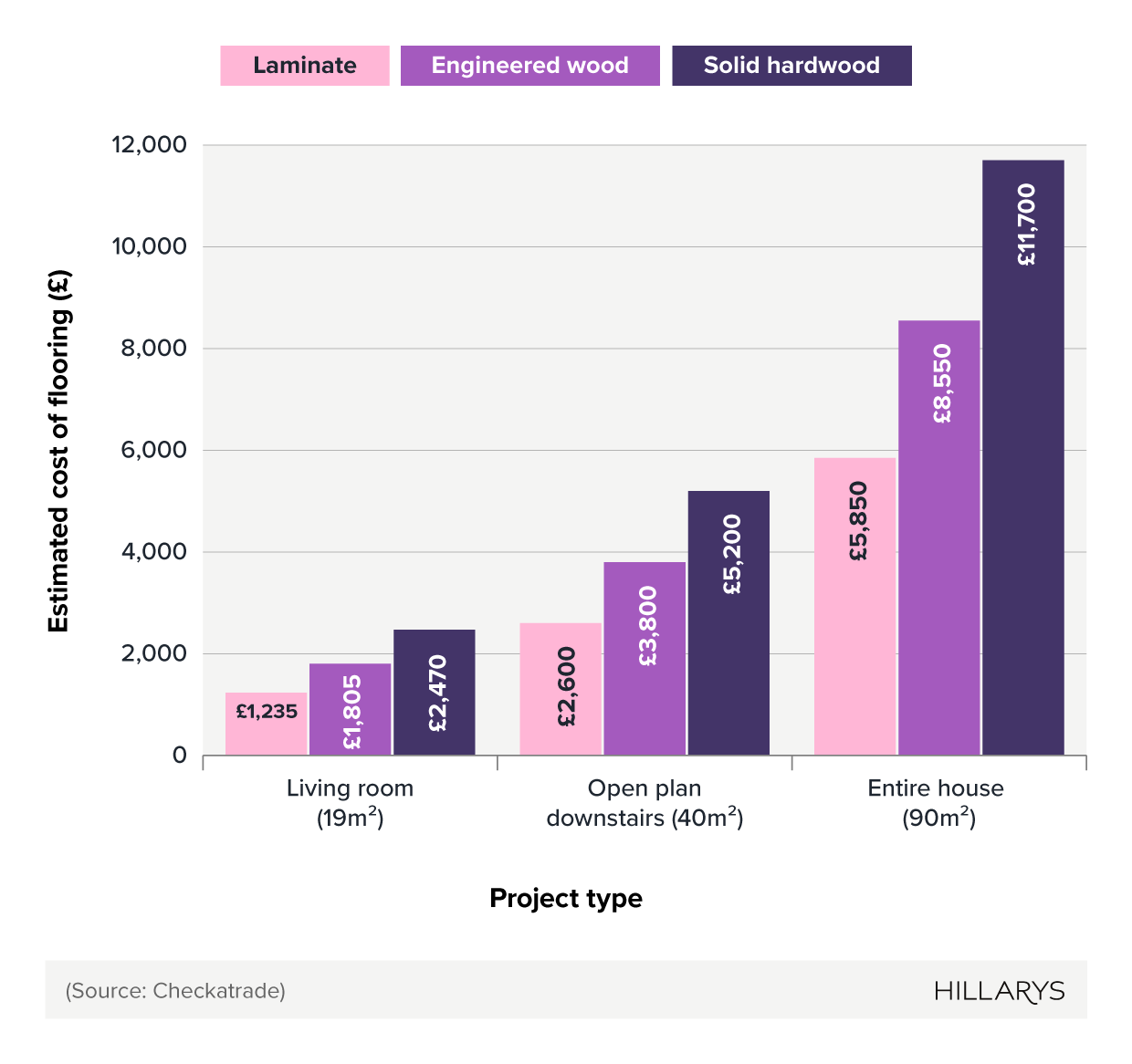
The average cost of flooring a 3-bed house in the UK will vary according to the type of flooring and the size of the property.
For example, the cost of laminate flooring in a 19m² living room is likely to be around £1,235. Upgrade this to solid hardwood, and you can expect the cost to double. The same can also be said for an open-plan downstairs flooring project of 40m² (£2,600 vs. £5,200) and reflooring the entire house (£5,850 vs. £11,700).
On average, engineered wood costs almost two-fifths (37.5%) more than laminate flooring but is around a third (31.1%) cheaper compared to solid hardwood.
The average carpet fitting cost can vary between £20 and £35 an hour (or £150 - £250 per day), depending on your location. The carpet cost itself (not including installation) will change according to the type, style, and material it's made from. This could range from £6 per m² up to £80 per m² or above.
| Potential costs associated with new carpets | Average price |
|---|---|
| Carpet installation (hourly rate) | £20 - £35 |
| Carpet installation (daily rate) | £150 - £250 |
| Carpet (not inc. installation) | £6 - £60+ per m² |
| Underlay and fitting | £8 - £12 per m² |
| Standard size bedroom | £550 - £650 + VAT |
| Standard size lounge | £550 - £650 + VAT |
| Single, straight staircase | £150 - £250 + VAT |
| 12 x 12 room (14m²) | £300 - £800 |
| 1-bed house | £400 - £800 |
| 2-bed house | £700 - £1,400 |
| 3-bed house | £1,000 - £2,000+ |
| 4-bed house | £1,200 - £2,500+ |
| Preparing the floor (i.e. floor levelling) | £10 - £15 per m² |
| Adjusting door frames | £20 - £30 per door |
| Delivery | £30+ |
Source: Information from Checkatrade's guide Carpet fitting: Cost breakdown 2026
Of course, the size of the property and rooms being carpeted can influence the final price. For example, the average cost to carpet a 3 bedroom house in the UK is usually somewhere between £1,000 and £2,000+ (around a third more (42.9%) compared to a standard 2-bed property).
The average cost of new windows will vary depending on the type of window you desire, the material it is made from, and how many you wish to install.
For example, a standard uPVC casement-style window may range from £372 - £691 per window. Upgrade to aluminium and you could expect the average cost per window to almost double. At the other end, composite casement windows are generally the most expensive at £2,046 - £3,596 – around five times more expensive than uPVC.
| uPVC | Aluminium | Timber | |
|---|---|---|---|
| Casement | £525 - £670 | £700 - £870 | £1,630 - £1,975 |
| Sash | £805 - £915 | £1,050 - £1,300 | £2,450 - £2,775 |
| Tilt-and-turn | £670 - £835 | £875 - £1,085 | £2,040 - £2,515 |
| Bay | £1,755 - £2,890 | £2,265 - £3,735 | £5,265 - £8,675 |
| Bow | £1,815 - £2,890 | £2,265 - £3,860 | £5,435 - £8,960 |
Source: Information from the Federation of Master Builders’ article How much do new windows cost? | UK 2026 prices
Sash windows typically range between £719 and £2,356, according to their type of material. At the lower end, uPVC sash windows have an average cost of £719 - £1,159 (around twice as much as uPVC casement ones). By comparison, timber sash windows vary between £1,612 and £2,356 per window – a difference in cost of around three-quarters (76.6%).
Alternatively, tilt-and-turn windows tend to cost between £589 and £739 per window regardless of their material and are typically around half the cost compared to bay or bow-style windows.
According to the Federation of Master Builders (FMB), wooden window frames should be repaired, repainted, or revarnished every one to five years to keep them in good condition. For those looking at DIY maintenance, this may cost around £100 and take between two and six hours per window to complete.
The average cost of installing new uPVC windows for a standard 3-bed house in the UK is £4,130, not including maintenance. Assuming these windows last 20 years, the yearly cost should be approximately £200.
That said, replacing the wooden windows of a 3-bed property could set you back about £10,850. With average upkeep costs of £1,000 over 40 years, this would equate to a lifetime cost of £11,850 for wooden windows (or £296 per year).
This means that by choosing uPVC windows over wooden ones, you could save around £96 a year.
According to Aviva’s How We Live report, almost seven million UK homeowners plan to renovate their properties in 2025, with each home spending an average of more than £14,000 on home improvements by 2027.
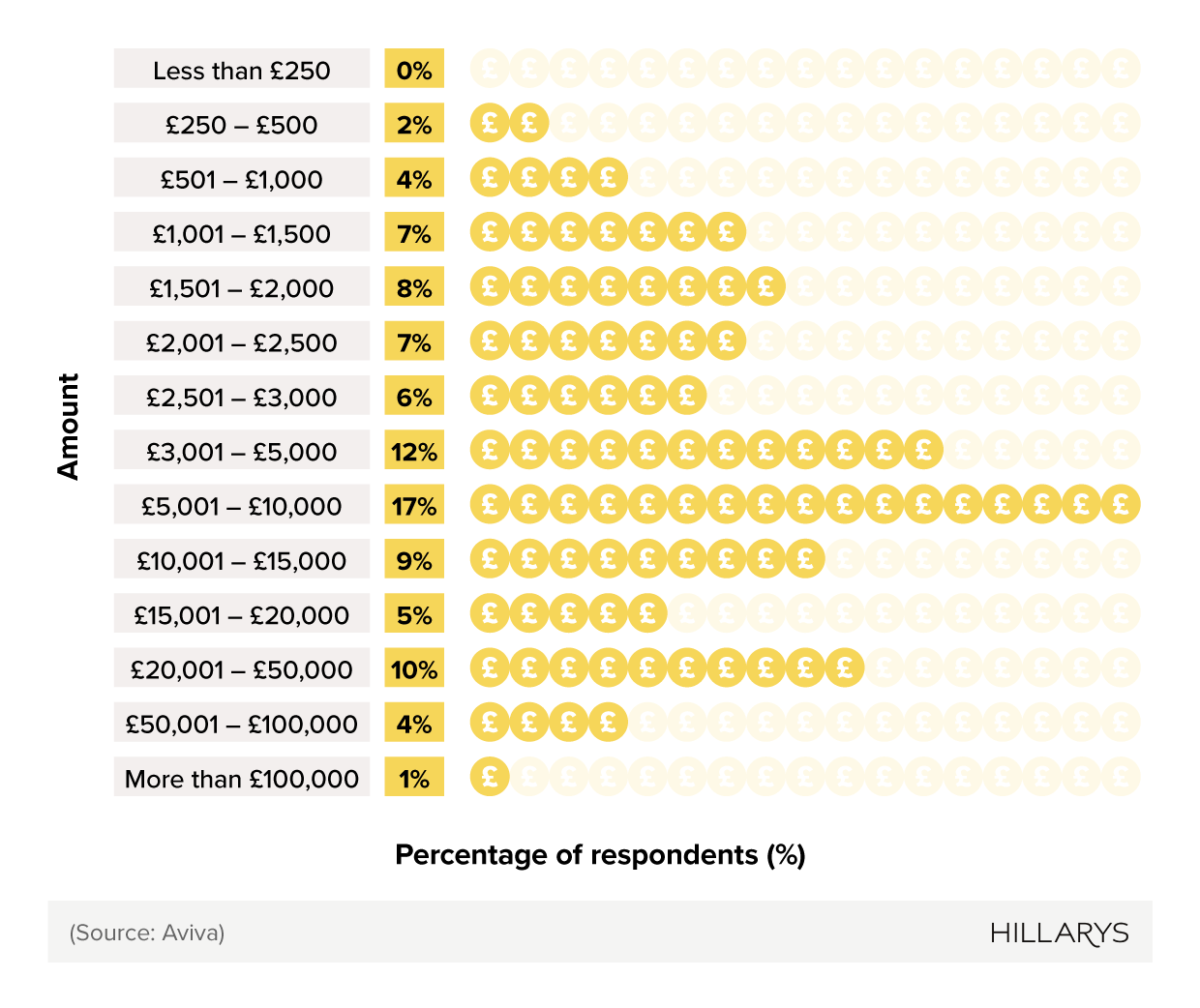
UK home renovation statistics from Aviva indicate that 17% of those surveyed plan to spend between £5,001 and £10,000 on property refurbishment in 2025 – the most popular amount from the study. This was followed by just over one in 10 (12%) who intend to spend £3,001 - £5,000 on renovating their homes.
A similar proportion (10%) of those surveyed by Aviva claim to have budgeted between £20,001 and £50,000 for home improvements in 2025 – around double the percentage who plan on spending £15,001 – £20,000.
| Year | Median average renovation spend |
|---|---|
| 2023 | £17,000 |
| 2024 | £21,440 |
| 2025 | £20,000 |
Source: Information from Houzz’s report Houzz & Home: Study Renovation Trends, p. 5
As of 2025, the average annual spending on home improvements in the UK was £20,000. This represented a decrease of 6.7% from £21,440 in 2024 but an increase of 17.6% compared with £17,000 in 2023.
As of 2024 – 25, home renovation statistics from the ONS suggest a typical UK household spent £43.90 per week on property improvements. This included £11.90 on maintenance and repair work and £32 on alterations and improvements, together accounting for almost a fifth (18.7%) of average weekly housing expenditure.
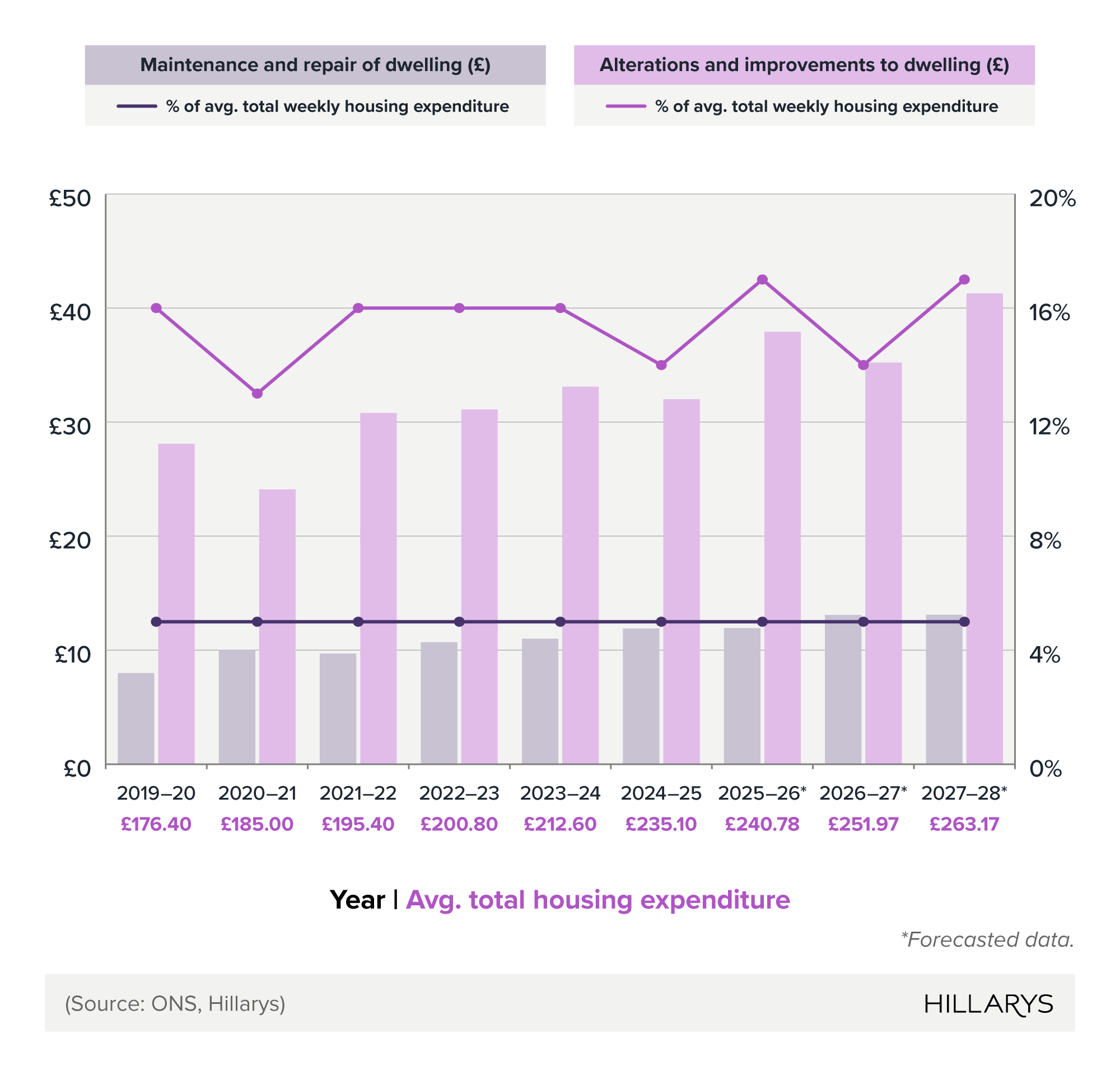
| Year | Maintenance and repair of dwelling | % of avg. total weekly housing expenditure | Alterations and improvements to dwelling | % of avg. total weekly housing expenditure | Avg. total housing expenditure |
|---|---|---|---|---|---|
| 2019-20 | £8 | 5% | £28.10 | 16% | £176.40 |
| 2020-21 | £10 | 5% | £24.10 | 13% | £185.00 |
| 2021-22 | £9.70 | 5% | £30.80 | 16% | £195.40 |
| 2022-23 | £10.70 | 5% | £31.10 | 16% | £200.80 |
| 2023-24 | £11 | 5% | £33.10 | 14% | £212.60 |
| 2024-25 | £11.90 | 5% | £32 | 14% | £235.10 |
| 2025-26* | £11.94 | 5% | £37.91 | 17% | £240.78 |
| 2026-27* | £13.09 | 5% | £35.21 | 14% | £251.97 |
| 2027-28* | £13.10 | 5% | £41.28 | 17% | £263.17 |
Source: Information from the Office for National Statistics’ dataset Family spending workbook 5: expenditure on housing, 2025 edition, tab 2.2. Forecasting by Hillarys.
Home renovation spending has generally increased over time. The average weekly amount spent on maintenance, repairs, alterations, and improvements rose from £36.10 in 2019–20 to £43.90 in 2024–25, representing an increase of more than a fifth (21.6%).
Looking ahead, average weekly spending is forecast to reach £54.38 by 2027–28. This would represent a rise of almost a quarter (23.9%) from 2024–25. Spending is expected to fluctuate slightly in the meantime, increasing to £49.85 in 2025–26, falling to £48.30 in 2026–27 and rising again the following year.
Generally speaking, as household income increases, so does the average weekly expenditure on home improvements (both in terms of the amount and as a percentage of total weekly household spending).
In 2025, those in the lowest-income group typically spent £16.50 a week on home maintenance, repairs, alterations, and improvements, equivalent to around one-sixth (16.8%) of their average weekly housing expenditure. Those in middle-income households, such as group five, spent £43.30 a week improving their properties – more than two and a half times the amount spent by the lowest-income group. Their average weekly housing expenditure was around twice as high, at £199 compared with £98.50.
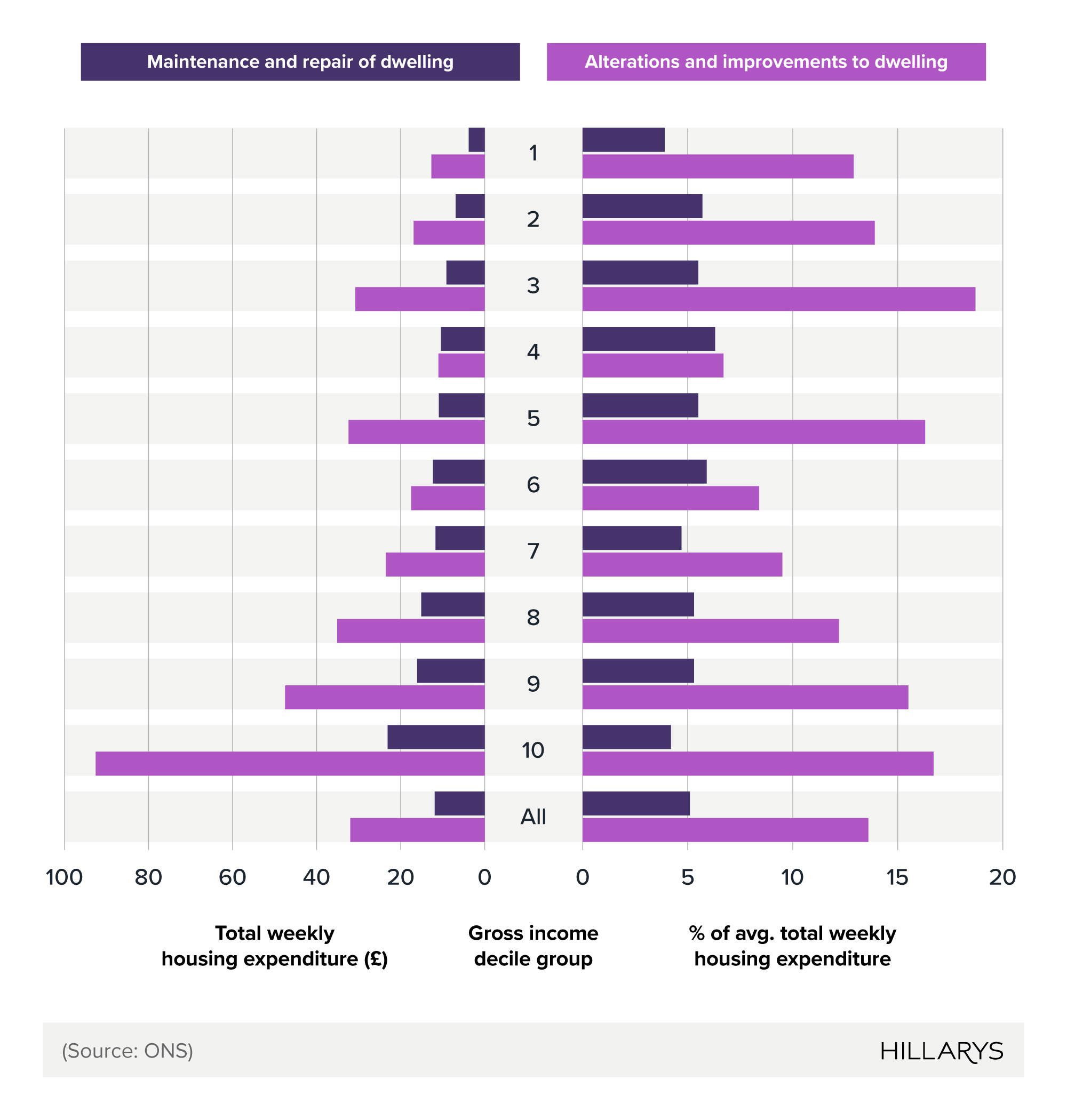
| Gross income decile group | Maintenance and repair of dwelling | % of avg. total weekly housing expenditure | Alterations and improvements to dwelling | % of avg. total weekly housing expenditure | Avg. weekly housing expenditure |
|---|---|---|---|---|---|
| 1 | £3.80 | 3.9% | £12.70 | 12.9% | £98.50 |
| 2 | £6.90 | 5.7% | £16.90 | 13.9% | £122 |
| 3 | £9.10 | 5.5% | £30.80 | 18.7% | £164.40 |
| 4 | £10.40 | 6.3% | £11 | 6.7% | £164.40 |
| 5 | £10.90 | 5.5% | £32.40 | 16.3% | £199 |
| 6 | £12.30 | 5.9% | £17.50 | 8.4% | £207.80 |
| 7 | £11.70 | 4.7% | £23.50 | 9.5% | £248.20 |
| 8 | £15.10 | 5.3% | £35.10 | 12.2% | £287 |
| 9 | £16.10 | 5.3% | £47.50 | 15.5% | £305.80 |
| 10 | £23.10 | 4.2% | £92.60 | 16.7% | £554.80 |
| All | £11.90 | 5.1% | £32 | 13.6% | £235.10 |
Source: Information from the Office for National Statistics’ dataset Family spending workbook 5: expenditure on housing , 2025 edition, tab 2.3.
The wealthiest UK households spent an average of £115.70 a week on household improvements in 2025. This contributed just over a fifth (20.9%) of their typical average weekly housing expenditure for the year and around seven times more than those in the lowest-income group.
Overall, those in income group three allocated the largest proportion of their housing expenditure to maintenance, repairs, alterations, and improvements, at just under a quarter (24.2%).
Across all income groups, the average UK household spent £43.90 a week improving and maintaining its home in 2025, or 18.7% of average weekly housing expenditure.
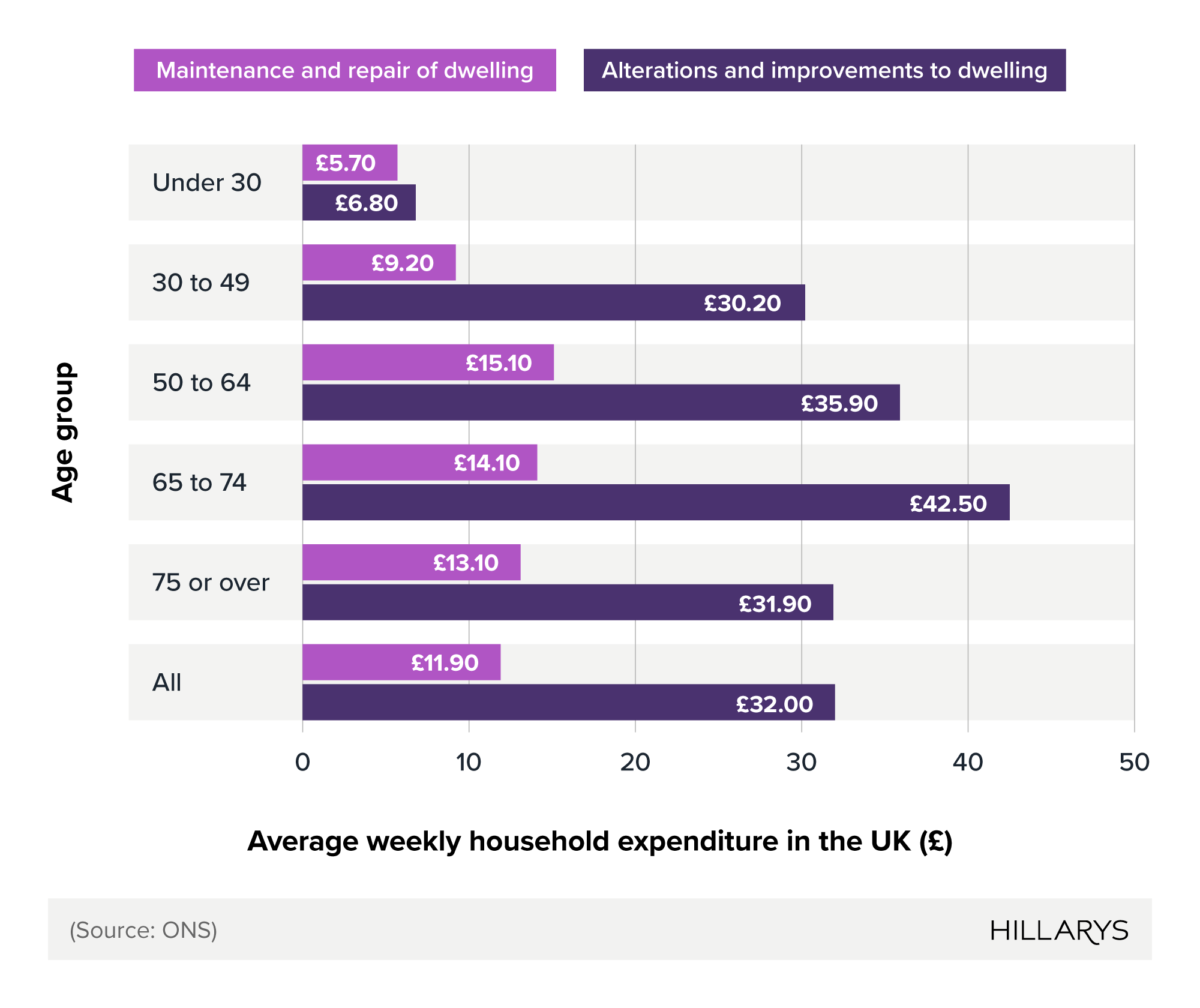
| Age group | Maintenance and repair of dwelling | % of avg. total weekly housing expenditure | Alterations and improvements to dwelling | % of avg. total weekly housing expenditure | Avg. weekly housing expenditure |
|---|---|---|---|---|---|
| Under 30 | £5.70 | 2% | £6.80 | 2.4% | £282.60 |
| 30 to 49 | £9.20 | 3.1% | £30.20 | 10.3% | £293.60 |
| 50 to 64 | £15.10 | 5.8% | £35.90 | 13.8% | £260 |
| 65 to 74 | £14.10 | 9.6% | £42.50 | 29.1% | £146.20 |
| 75 or over | £13.10 | 11.3% | £31.90 | 27.4% | £116.30 |
| All | £11.90 | 5.1% | £32 | 13.6% | £235.10 |
Source: Information from the Office for National Statistics’ dataset Family spending workbook 5: expenditure on housing, 2025 edition, tab 2.4.
Home renovation trends from the ONS suggest that average weekly spending on maintenance, repairs, alterations, and improvements generally increases with age, peaking among those aged 65 – 74 before declining for those aged 75 or over.
Using the most recent data available from 2025, those under the age of 30 tend to spend the least on home renovation projects at £12.50 per week (or 4.4% of their average weekly spend on housing).
Homeowners aged 65 – 74 spent the highest amount, averaging £56.60 per week. This represented 38.77% of their average weekly housing expenditure. Those aged 50–64 recorded the next-highest weekly spend, at £51.
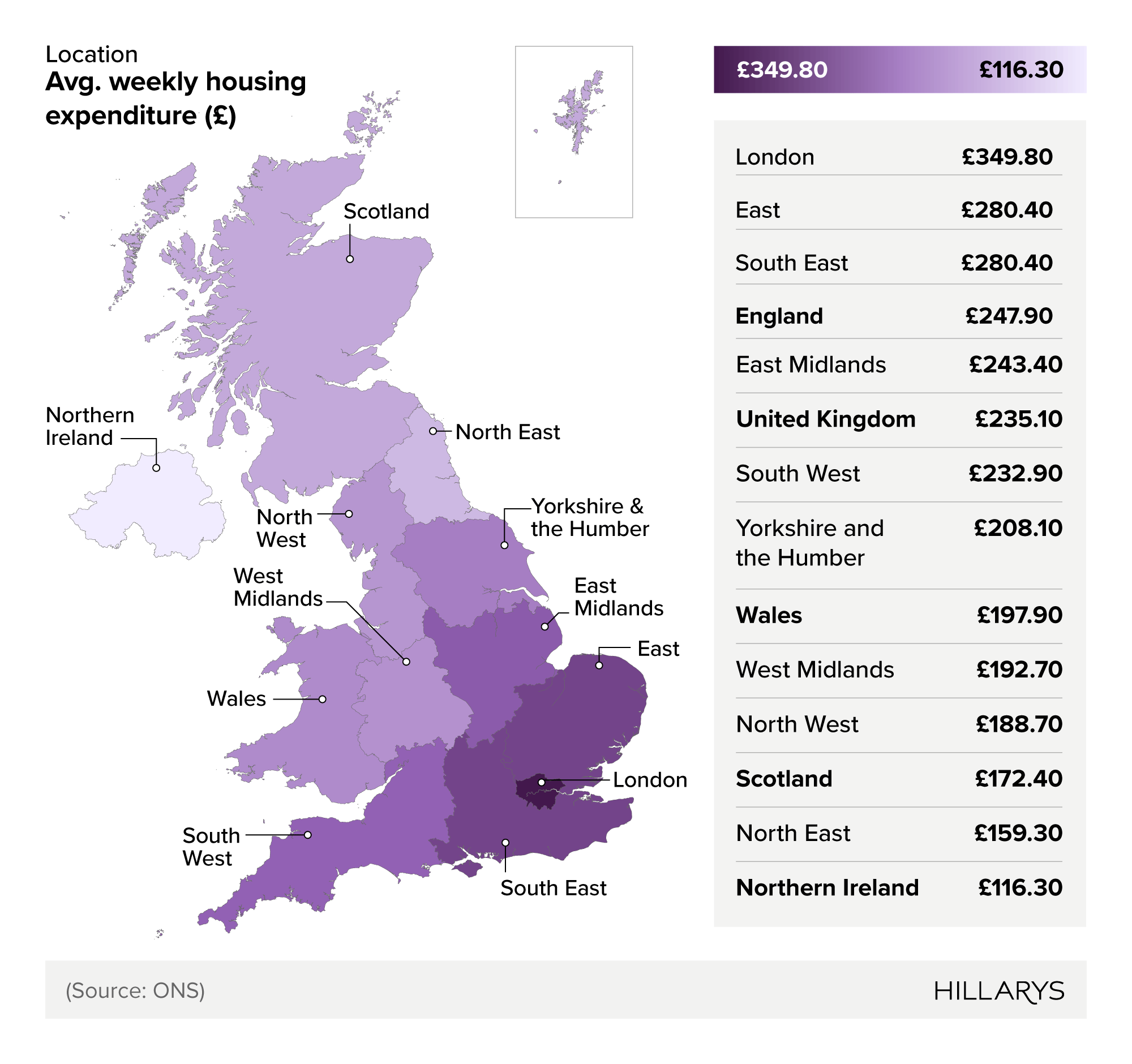
| Location | Maintenance and repair of dwelling | % of avg. total weekly housing expenditure | Alterations and improvements to dwelling | % of avg. total weekly housing expenditure | Avg. weekly housing expenditure |
|---|---|---|---|---|---|
| United Kingdom | £11.90 | 5.06% | £32 | 13.61% | £235.10 |
| England | £12.20 | 4.92% | £32.60 | 13.15% | £247.90 |
| North East | £11.20 | 7.03% | £16.20 | 10.17% | £159.30 |
| North West | £7.20 | 3.82% | £32.30 | 17.12% | £188.70 |
| Yorkshire and the Humber | £12.70 | 6.10% | £24.20 | 11.63% | £208.10 |
| East Midlands | £9 | 3.70% | £21.60 | 8.87% | £243.40 |
| West Midlands | £8.90 | 4.62% | £25 | 12.97% | £192.70 |
| East | £16.70 | 5.96% | £46.80 | 16.69% | £280.40 |
| London | £13.70 | 3.92% | £30.90 | 8.83% | £349.80 |
| South East | £12.80 | 4.56% | £39.90 | 14.23% | £280.40 |
| South West | £17 | 7.30% | £40.60 | 17.43% | £232.90 |
| Wales | £8.30 | 4.19% | £36.90 | 18.65% | £197.90 |
| Scotland | £11.60 | 6.73% | £29.80 | 17.29% | £172.40 |
| Northern Ireland | £10.10 | 8.68% | £13.50 | 11.61% | £116.30 |
Source: Information from the Office for National Statistics’ dataset Family spending workbook 5: expenditure on housing, 2025 edition, tab 2.4.
UK home renovation statistics reveal that households in the East spend the highest amount on home improvements, averaging £63.50 per week. This was 2.7 times the £23.60 spent by households in Northern Ireland, which recorded the lowest weekly amount.
Households in the South West allocated the largest proportion of their average weekly housing expenditure on home improvements, at almost a quarter (24.73%). Scotland ranked close behind at 24.02%.
By contrast, the East Midlands recorded the lowest proportion, accounting for around one-eighth (12.57%) of average weekly housing expenditure. London had the next-lowest share, at 12.75%.
Although London households had the highest average weekly housing expenditure at £349.80, they spent £44.60 on maintenance and improvements. This was 60p less than households in Wales, despite their average weekly housing expenditure being £151.90 higher.
The UK home improvement market was estimated to be worth $15 billion (~£11.3 billion) as of 2025.
According to projections by IMARC Group, this could reach a value of $21.8 billion (~£16.4 billion) by 2034, at a compound annual growth rate (CAGR) of 4.23% between 2025–33.
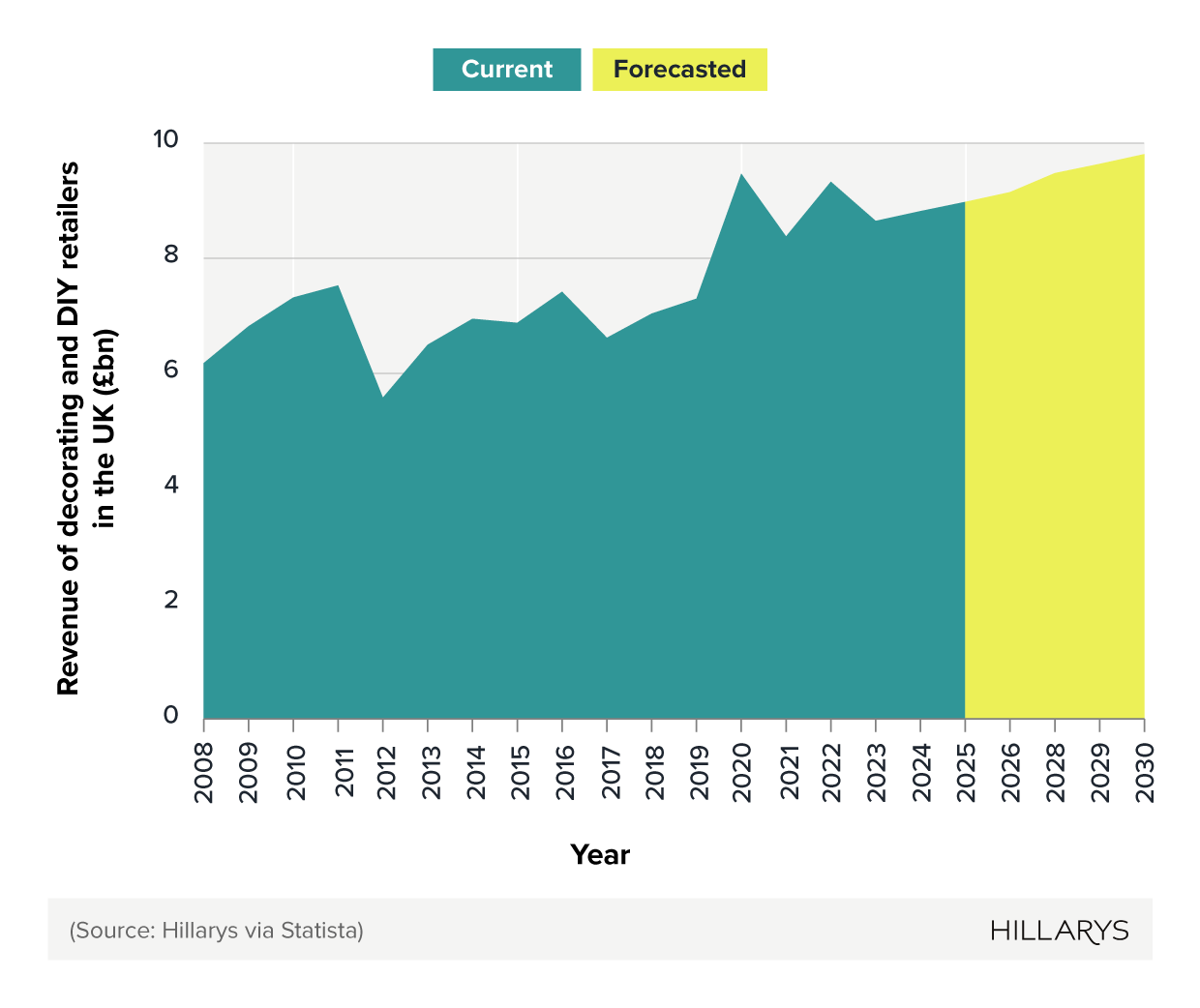
DIY market trends for 2025–30 suggest revenue figures for UK DIY and decorating retailers could reach £9.81 billion by the end of the decade – a rise of almost a tenth (9.2%) in the space of five years.
The five-year growth rate for 2020–25 indicates a decrease of around 5.1%, yet the 10-year growth rate is more positive at 30.5%, suggesting the period between 2020 – 25 was a blip rather than the norm for DIY and decorating revenue in the UK.
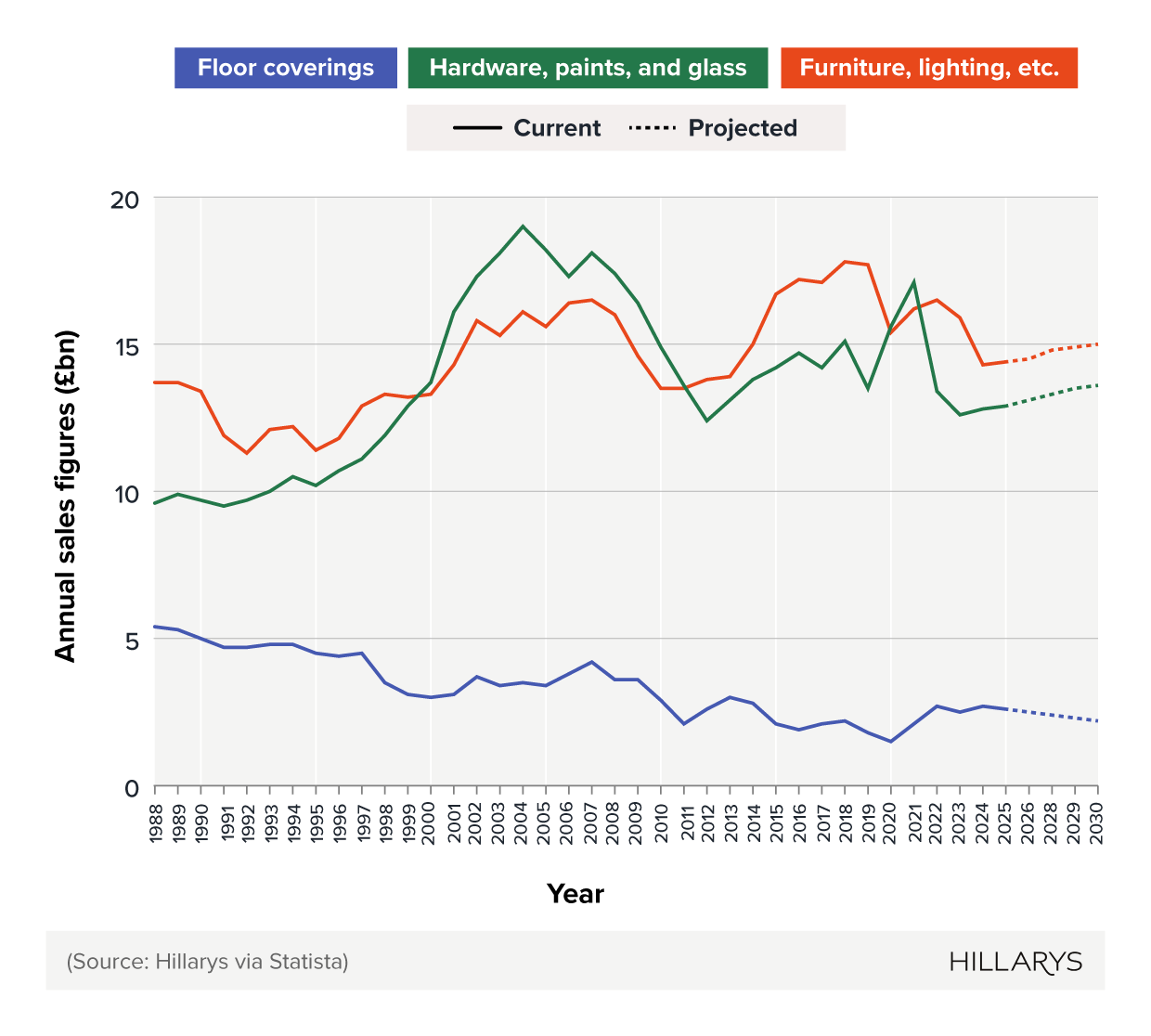
Sales figures for the UK’s DIY and decorating sector fluctuated between 1988 and 2024, rising to a peak of £19 billion in 2004 for hardware, paints, and glass. Since then, revenue in this area of the UK DIY market has been on a general downward trend, rising again during the Covid years to £17.1 billion in 2021 before falling again to around £12.8 billion in 2024 (a fall of around a quarter (25.1%) in the space of three years).
This fluctuating trend is mirrored by sales revenue for furniture and lighting, reaching a peak of £17.8 billion in 2018 – just over half (50.1%) of the UK’s overall DIY and decorating revenue for the year.
Sales revenue for flooring has remained relatively low since 1988 and followed a general pattern of decline, falling from a peak of £5.4 billion down to £2.7 billion in 2024. This represents a 50% decrease in the space of 36 years.
| Year | Hardware, paints, and glass | Floor coverings | Furniture, lighting, etc. | |||
|---|---|---|---|---|---|---|
| Sales index | Sales (£bn) | Sales index | Sales (£bn) | Sales index | Sales (£bn) | |
| 2015 | 106.2 | 14.2 | 75.2 | 2.1 | 101 | 16.7 |
| 2016 | 109.4 | 14.7 | 68.4 | 1.9 | 104.1 | 17.2 |
| 2017 | 105.7 | 14.2 | 78.2 | 2.1 | 103.7 | 17.1 |
| 2018 | 112.6 | 15.1 | 78.6 | 2.2 | 107.9 | 17.8 |
| 2019 | 101.1 | 13.5 | 65.3 | 1.8 | 107.1 | 17.7 |
| 2020 | 116.6 | 15.6 | 55.5 | 1.5 | 92.9 | 15.4 |
| 2021 | 127.5 | 17.1 | 77.8 | 2.1 | 97.9 | 16.2 |
| 2022 | 100 | 13.4 | 100 | 2.7 | 100 | 16.5 |
| 2023 | 94.1 | 12.6 | 92.8 | 2.5 | 96 | 15.9 |
| 2024 | 95.6 | 12.8 | 99.7 | 2.7 | 86.4 | 14.3 |
| 2025 | 96.6 | 12.9 | 95.5 | 2.6 | 87.1 | 14.4 |
| 2026* | 97.6 | 13.1 | 92.3 | 2.5 | 87.9 | 14.5 |
| 2027* | 98.6 | 13.2 | 89.1 | 2.5 | 88.7 | 14.7 |
| 2028* | 99.5 | 13.3 | 85.9 | 2.4 | 89.4 | 14.8 |
| 2029* | 100.5 | 13.5 | 82.7 | 2.3 | 90.1 | 14.9 |
| 2030* | 101.5 | 13.6 | 79.5 | 2.2 | 90.9 | 15 |
Source: Information from Statista’s report Revenue of decorating and DIY retailers in the United Kingdom (UK) from 2008 to 2023 (in million British pounds). Forecast by Hillarys.
As of 2024, the UK DIY and decorating industry generated an estimated £29.8 billion in revenue. By the start of the next decade, this is predicted to reach £30.8 billion – a rise of almost 3.4% in the space of six years, suggesting the UK’s DIY market may begin to stagnate after a recent period of turbulence.
Using 2022 as the base year, the revenue generated by the sale of hardware, paints, and glass in 2024 was around 4.4% less by comparison but is expected to pick up again by 2029. However, the future is less positive for floor coverings, furniture and lighting, with an anticipated reduction in the sales index for 2030 of more than a fifth (20.5%) and almost a tenth (9.1%), respectively, compared to 2022 figures.
Before 2022, the sales index for hardware, paints, and glass was generally above 100, meaning sales figures were higher by comparison. No more so than in 2021, when the figure stood at more than a quarter (+27.5%) – likely reflective of the rise of DIY projects completed by people in the UK during the Covid-19 pandemic.
That said, the revenue generated by flooring sales was higher in 2022 than in any year between 2015 and 2021, as a comparison, ranging between an index score of 78.6 (or 21.4% less revenue) in 2018 and 55.5 (or 44.5% less) in 2020.
According to the sales index for UK furniture and lighting, figures dropped to their lowest in 2024 at 86.4. In other words, the revenue generated in this year from the sale of furniture and lighting was around a seventh (13.6%) less compared to 2022.
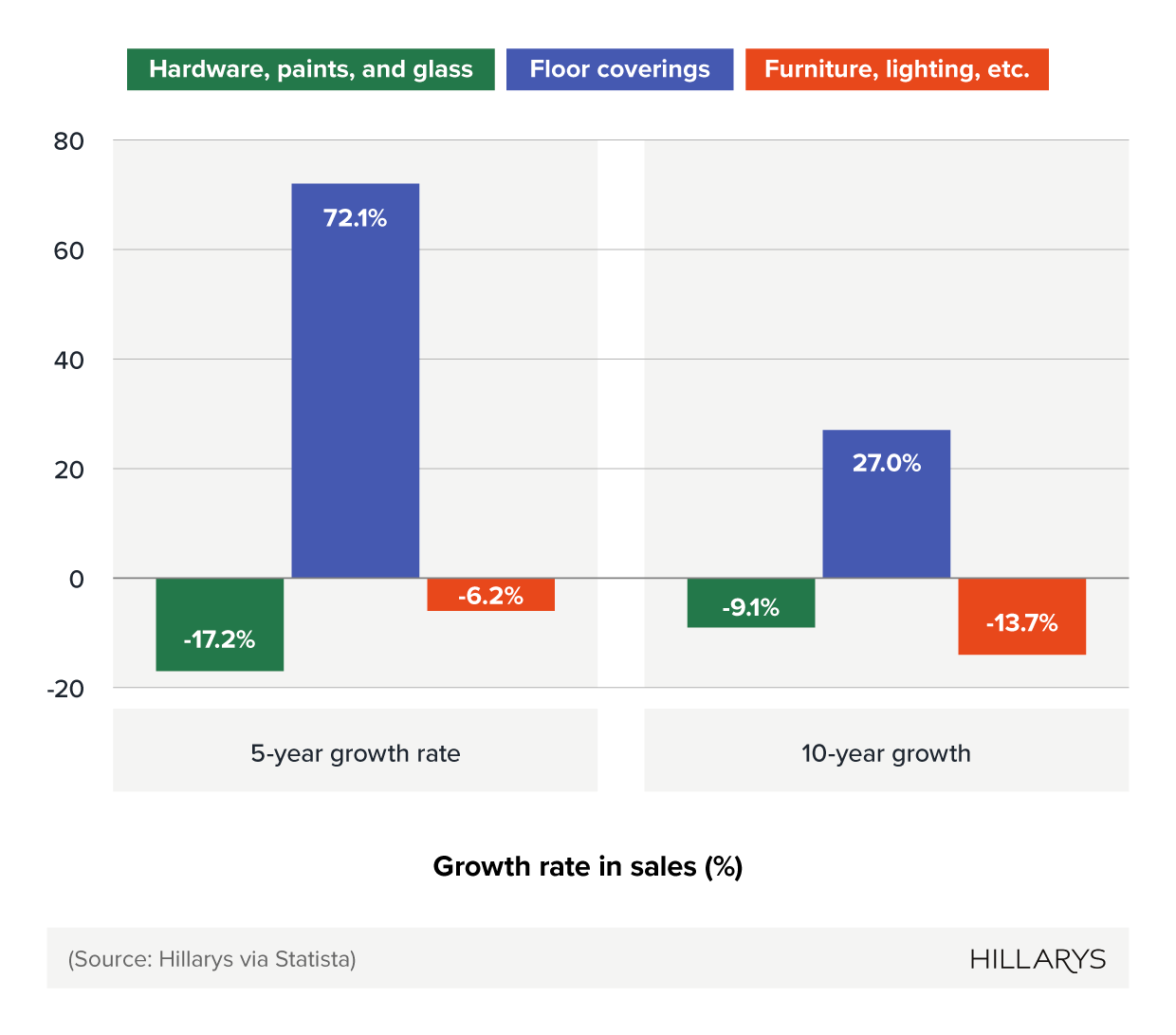
Hardware, paints, and glass experienced a negative growth rate of almost a fifth (-17.2%) between 2020 and 2025 and just under a tenth (-9.1%) for 2015 – 2025. This suggests the sector is struggling in terms of sales when it comes to these DIY items.
A similar trend was seen for furniture and lighting, at -6.2% and -13.7%, respectively.
That said, there was substantial growth in sales figures for floor coverings between 2020–25, at almost three-quarters (72.1%) and more than a quarter growth from 2015 to 2025.
As of 2024, there were approximately 6,265 specialist stores in the UK for the retail sale of hardware, paints, and glass. This represents general positive growth from 2008, when there were 5,618 stores across the country – a rise of more than a tenth (11.5%) over 16 years.
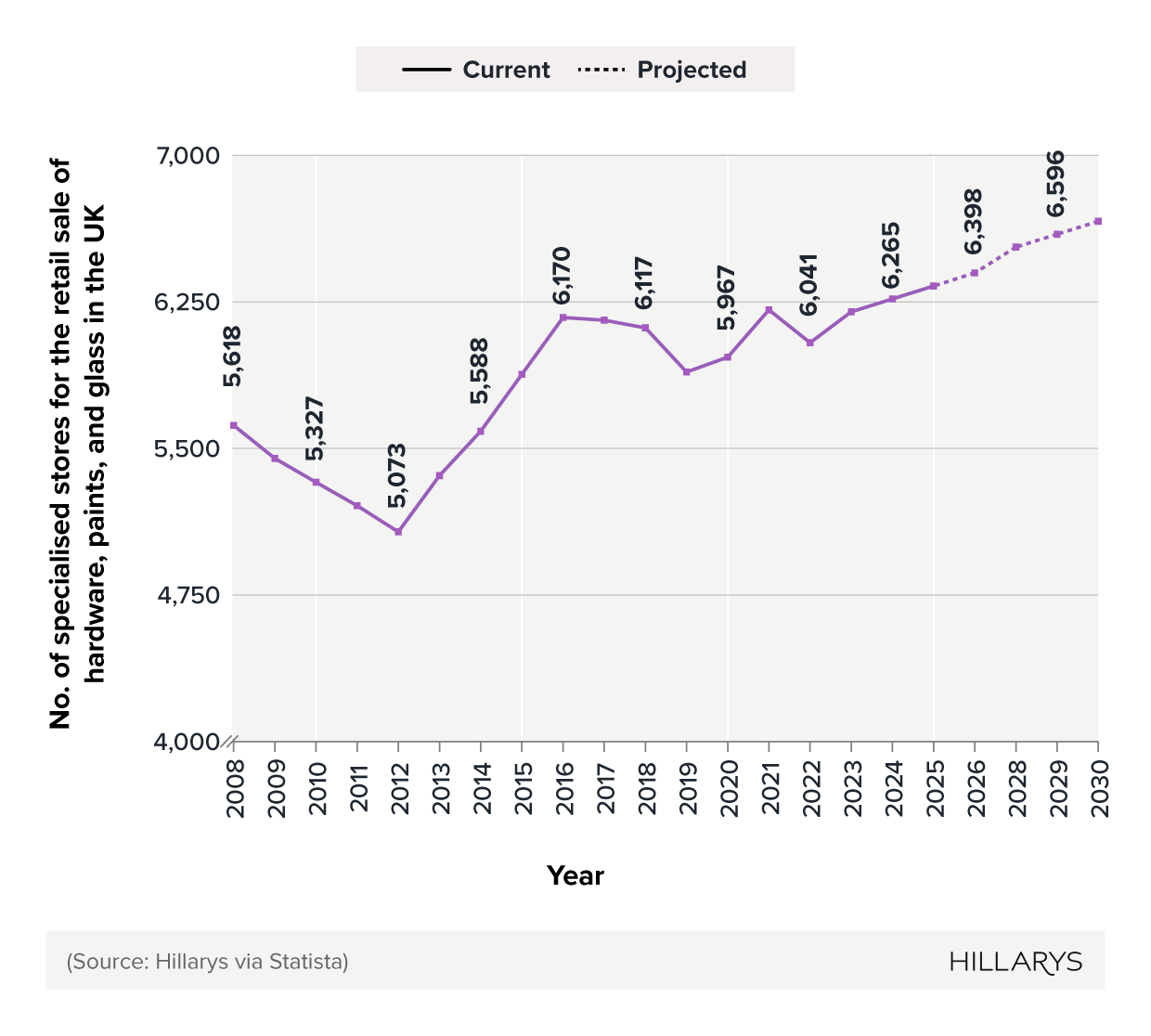
DIY market trends for 2025–2030 suggest that the number of stores specialising in the retail sale of hardware, paints, and glass could reach 6,652 by the end of the decade – an increase of 6.3% from 2024 figures.
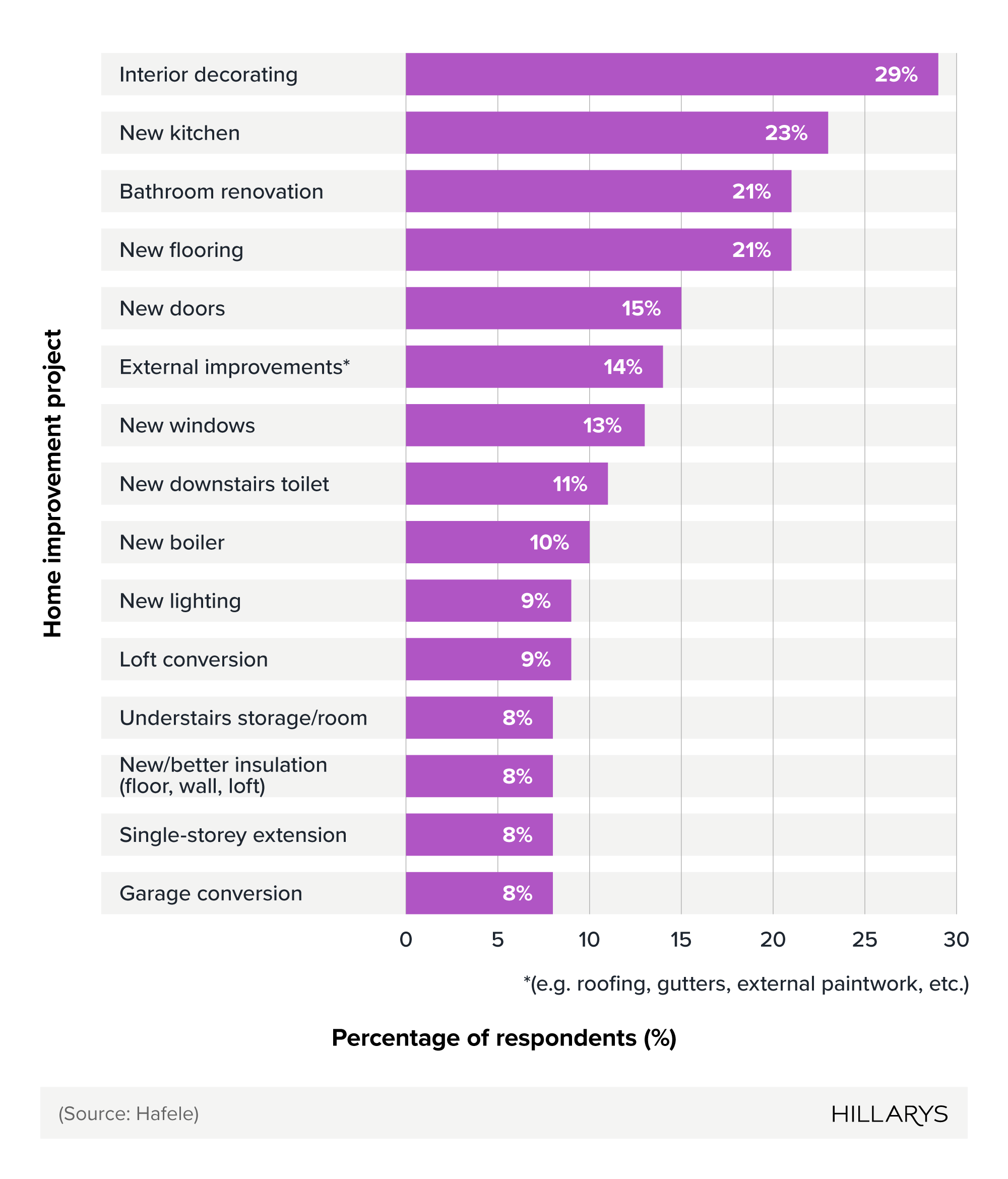
Almost one in three (29%) homeowners surveyed by Häfele plan to do interior decorating in 2025, making it the most common option for DIY home renovation projects.
Just under a quarter (23%) intend to install a new kitchen, with around a fifth (21%) looking to renovate their bathroom or lay new flooring.
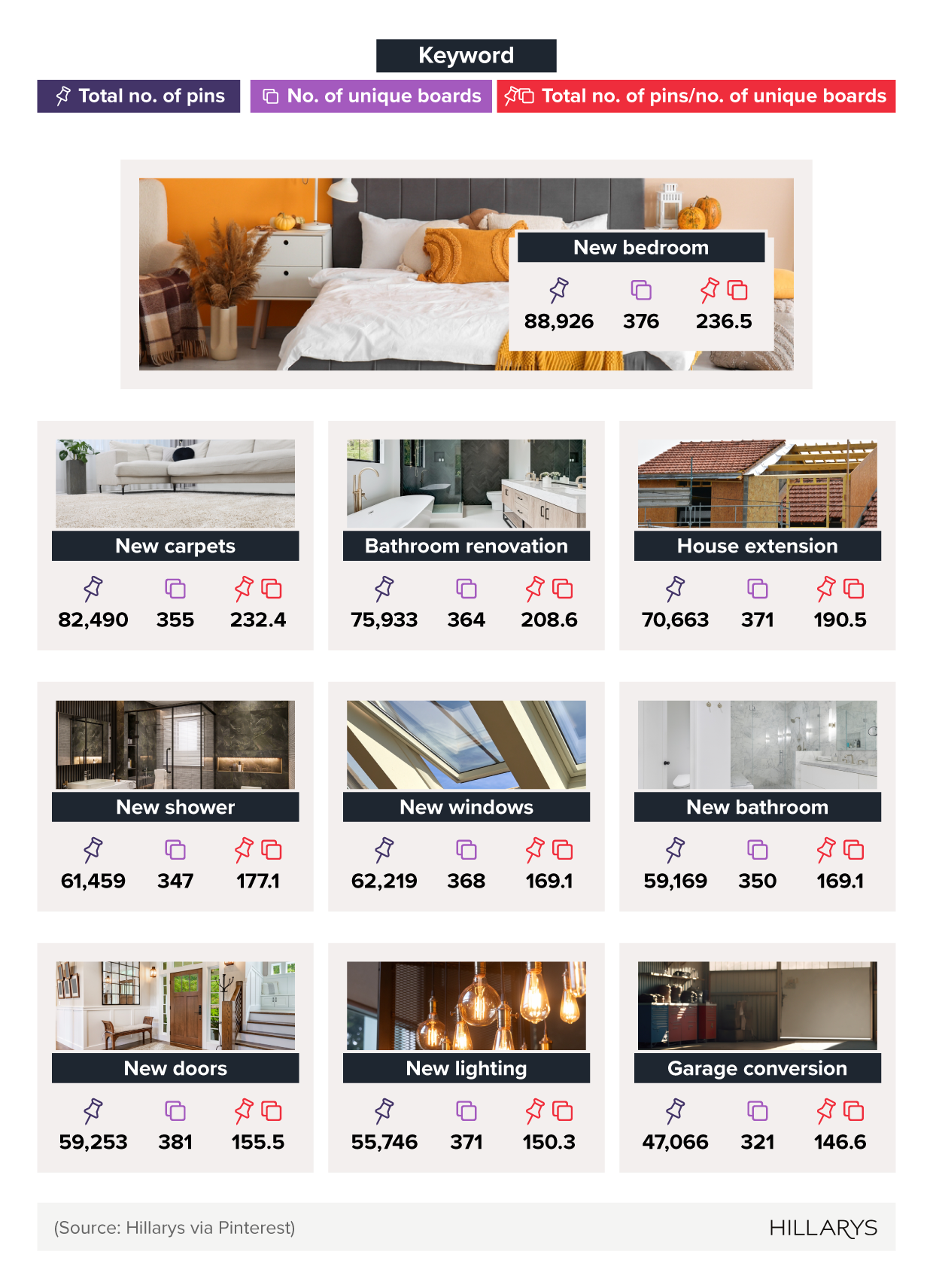
According to data collected by Hillarys via Pinterest, new bathrooms are one of the most popular home renovation trends for 2025. With almost 89,000 pins across 376 unique boards, this was the highest for both categories across all DIY keywords in the study.
This is followed closely by new carpets, with 82,490 pins over 355 unique boards, to give an average of 232.4 pins per board.
| Keyword | Total no. of pins | No. of unique boards | Total no. of pins/no. of unique boards |
|---|---|---|---|
| Loft conversion | 42,140 | 311 | 135.5 |
| Garden makeover | 33,414 | 312 | 107.1 |
| New flooring | 31,950 | 315 | 101.4 |
| Bedroom renovation | 33,310 | 353 | 94.4 |
| Bathroom upgrade | 28,167 | 338 | 83.3 |
| Bedroom upgrade | 23,158 | 338 | 68.5 |
| New home office | 21,403 | 321 | 66.7 |
| Home Insulation | 13,173 | 250 | 52.7 |
| Understairs storage | 7,642 | 159 | 48.1 |
| Single-storey extension | 9,203 | 217 | 42.4 |
| Knock through rooms | 3,670 | 96 | 38.2 |
| Cellar conversion | 6,808 | 182 | 37.4 |
| New driveway | 9,410 | 340 | 27.7 |
| New downstairs toilet | 2,180 | 152 | 14.3 |
| New boiler | 1,853 | 182 | 10.2 |
Source: Information collected by Hillarys from Pinterest. See methodology for more information.
Bathroom renovations placed third on the list. Despite possessing nine more unique boards than new carpets, having around 8.3% fewer pins by comparison resulted in an average of 208.6 pins per board.
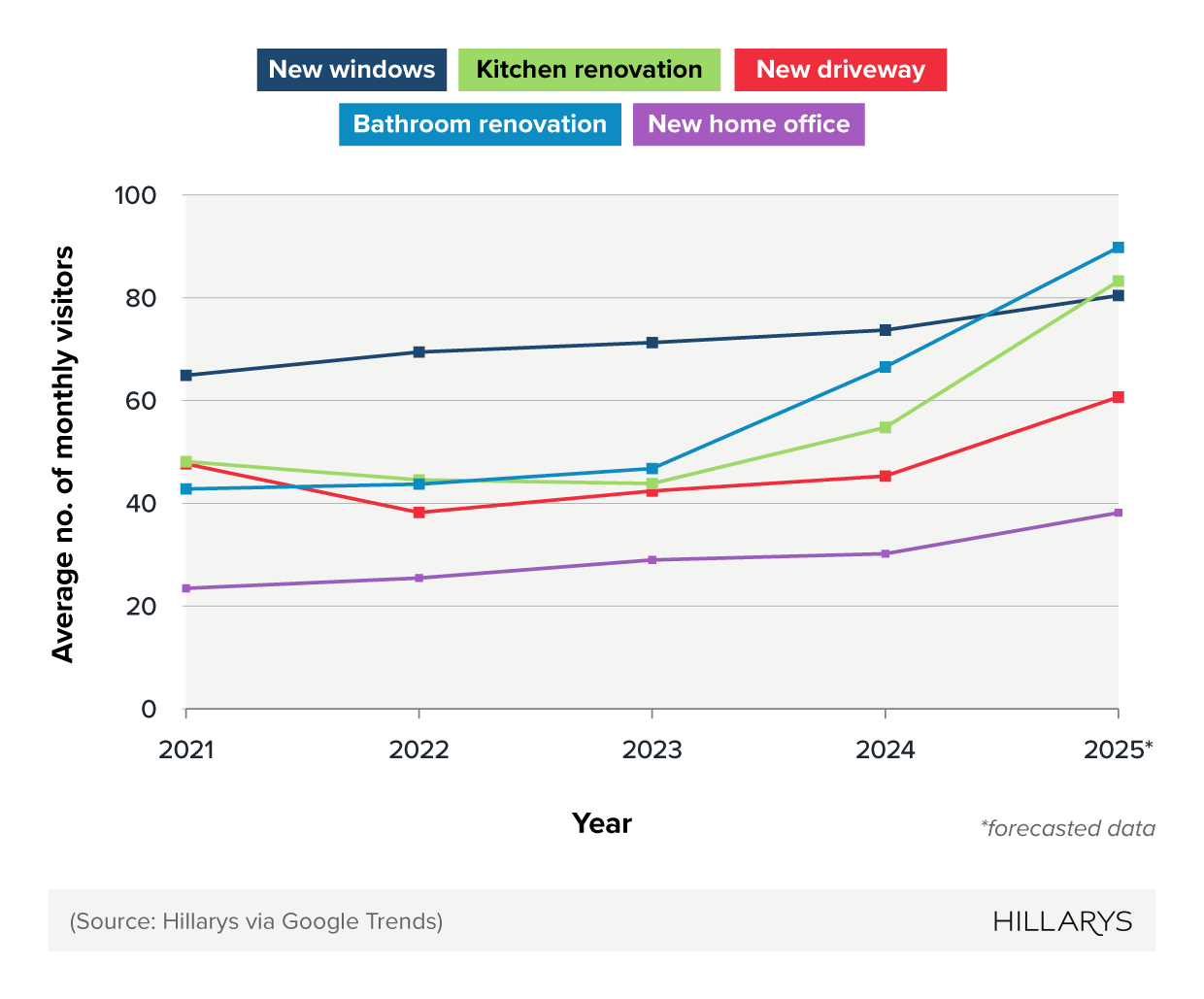
Google Trends data collected by Hillarys shows that new windows were one of the most commonly searched home renovation trends of 2024, with an average of 73.71 monthly searches. This keyword has seen sustained year-on-year growth in popularity since 2021 by almost a seventh (13.57%) in the space of three years (2021 – 2024).
Should current trends continue, ‘new windows’ is predicted to be the third most searched keyword associated with UK home renovation projects by the end of 2025, having been overtaken by ‘kitchen renovation’ and ‘bathroom renovation’ with respective averages of 83.25 and 89.81 monthly searches.
| Keyword | 2021 | 2022 | 2023 | 2024 | 2025 | Percentage growth (%) (2021-24) | Percentage growth (%) (2021-25) |
|---|---|---|---|---|---|---|---|
| Bathroom renovation | 42.79 | 43.73 | 46.77 | 66.54 | 89.81 | 55.51% | 109.90% |
| Kitchen renovation | 48.12 | 44.56 | 43.85 | 54.77 | 83.25 | 13.83% | 73.01% |
| New home office | 23.46 | 25.46 | 28.98 | 30.19 | 38.16 | 28.69% | 62.65% |
| New driveway | 47.67 | 38.21 | 42.4 | 45.31 | 60.68 | -4.96% | 27.28% |
| New windows | 64.9 | 69.44 | 71.28 | 73.71 | 80.43 | 13.57% | 23.91% |
| New shower | 38.46 | 40.04 | 40.92 | 41.52 | 47.64 | 7.95% | 23.86% |
| New bathroom | 66.19 | 59.81 | 61.06 | 64.08 | 77.82 | -3.20% | 17.57% |
| New Kitchen | 55.75 | 52.06 | 51.7 | 54.06 | 62.1 | -3.04% | 11.38% |
| New flooring | 64.48 | 60.71 | 56.83 | 60.67 | 67.58 | -5.91% | 4.80% |
| New carpets | 68.56 | 55.37 | 57.17 | 55.15 | 71.1 | -19.55% | 3.70% |
Source: Information collected by Hillarys from Google Trends. See methodology for more information.
In 2025, bathroom renovation was the most commonly searched home improvement term, with average Google Trends interest more than doubling (109.9%) compared with 2021.
Kitchen renovation followed a similar trend, with average interest increasing by almost three-quarters (73.01%) between 2021 and 2025.
| Keyword | 2021 | 2022 | 2023 | 2024 | 2025 | Percentage growth (%) (2021-24) | Percentage growth (%) (2021-25) |
|---|---|---|---|---|---|---|---|
| Garage conversion | 62.38 | 49.29 | 45.98 | 46.25 | 56.07 | -25.86% | -10.13% |
| New bedroom | 70.23 | 63.21 | 55.38 | 54.42 | 60.87 | -22.51% | -13.33% |
| Loft conversion | 58.4 | 48.62 | 40.75 | 39.67 | 46.01 | -32.07% | -21.22% |
| Single-storey extension | 53.71 | 39.48 | 33.43 | 34.38 | 40.95 | -35.98% | -23.75% |
| Garden makeover | 42.12 | 27.73 | 26.36 | 20.15 | 29.28 | -52.15% | -30.48% |
Source: Information collected by Hillarys from Google Trends. See methodology for more information.
In terms of declining search trends, average Google Trends interest in garden makeovers fell by almost a third (-30.48%) between 2021 and 2025, while interest in single-storey extensions decreased by almost a quarter (-23.75%)
"It’s little surprise that bathroom and kitchen renovations are some of the most searched home improvement projects. These can offer a high return on investment (ROI) in terms of boosting property prices, improving your home’s overall appeal and marketability when you come to sell, and generally making day-to-day life more comfortable/functional. However, not everyone wants to do, or can afford, an entire bathroom/kitchen makeover. Therefore, even making relatively minor alterations, such as installing new blinds and curtains, can rejuvenate your living spaces and refresh your décor (without having to do a full renovation project). They can also allow for better temperature and light control, energy efficiency, and noise reduction without having to break the bank."
Around three-quarters of homeowners carried out interior room renovations in 2025 (74%), which made them the most common project type. Outdoor upgrades followed closely at 72%, although they were the leading category in 2024 at 78%.
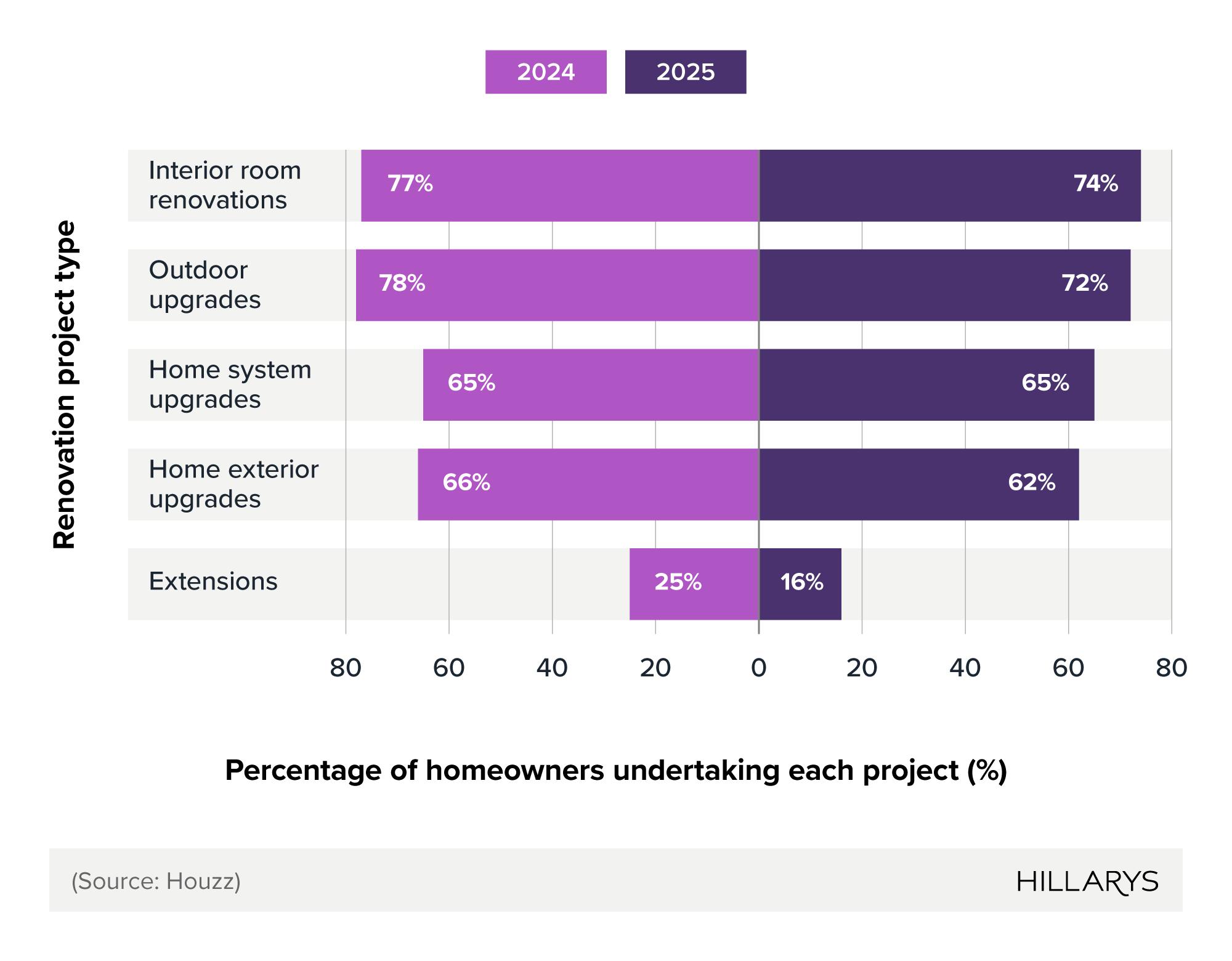
Almost two-thirds of homeowners upgraded their home systems in both years (65%), making this the only project type that remained unchanged. Home exterior upgrades fell slightly from 66% to 62%.
Extensions saw the largest decrease, falling by nine percentage points from one-quarter of homeowners in 2024 (25%) to around one in six in 2025 (16%). Interior renovations overtook outdoor upgrades as the most common project type, while most categories became less common year on year.
As of 2026, just over a quarter of homeowners (27%) started a renovation project because they needed to adapt their home for remote work. Changes in income or employment were cited by just over one in five homeowners (22%), while around one in seven renovated because of health or accessibility needs (14%).
| Homeowner Group | Reason | Percentage |
|---|---|---|
| Homeowners overall | Adjustments needed to work from home | 27% |
| Homeowners overall | Changes in income or employment | 22% |
| Homeowners overall | Health or accessibility needs | 14% |
| Millennials | Increased remote-work needs | 56% |
| Older homeowners | Employment or income changes, including retirement | 38% |
| Older homeowners | Changing health or accessibility needs | 25% |
Source: Information from Houzz’s press release Homeowners Plan to Stay in Their ‘Forever Homes’ Following Renovations, Houzz Study Finds
Remote-working needs were particularly common among Millennials, with more than half (56%) citing this as a reason for renovating. Among older homeowners, 38% were motivated by changes in employment or income, including retirement, while one-quarter (25%) renovated due to changing health or accessibility needs.
Around a third (33%) of homeowners surveyed by Aviva installed double glazing in their home at some point between 2023 and 2025, with a similar percentage (30%) indicating they would like to. This suggests growing interest in energy-efficient home improvements, with homeowners looking for high-quality, energy efficient products for their properties.
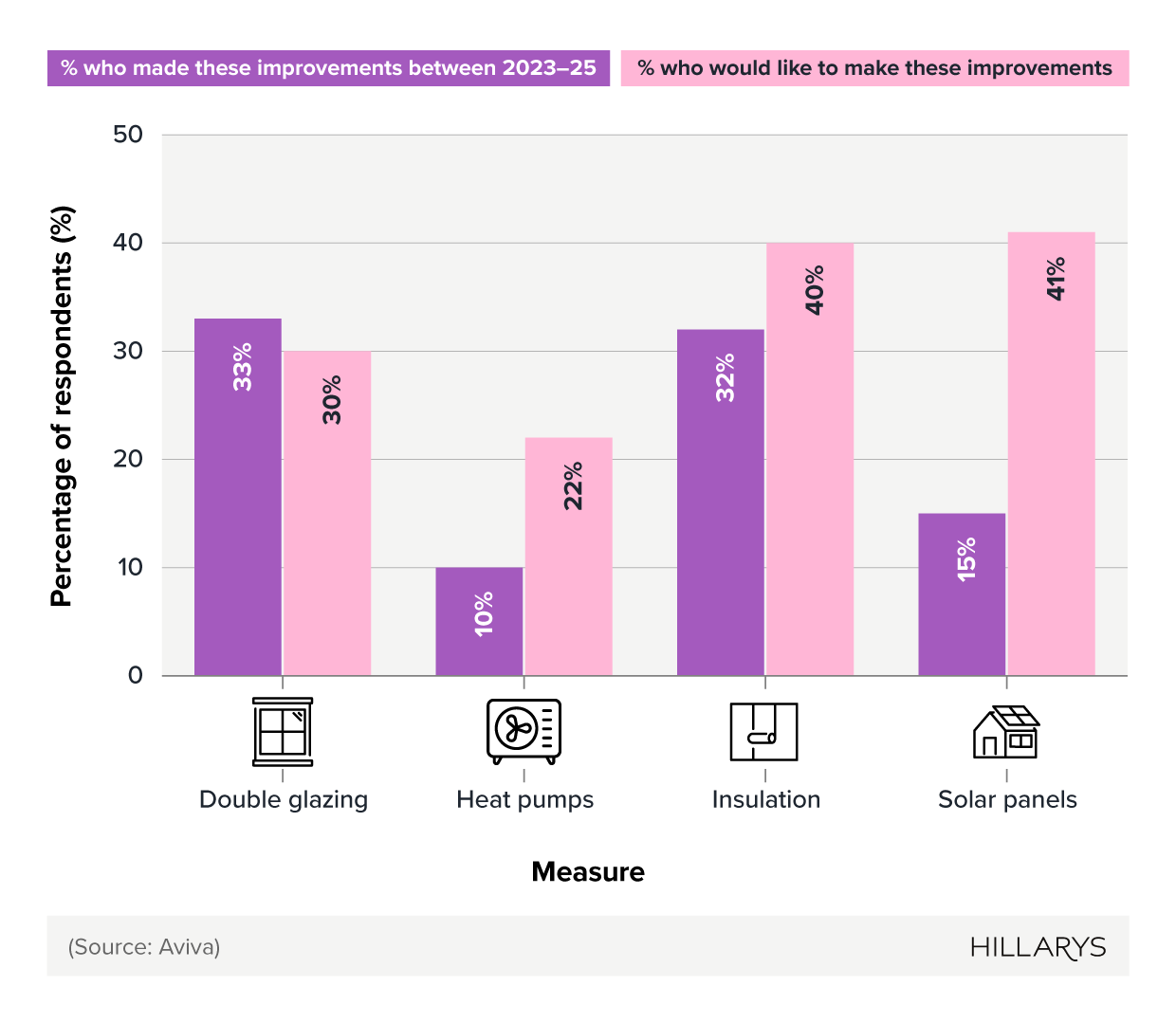
Installing insulation was the next most popular energy-efficient solution by UK homeowners when renovating their home, with roughly one in three (32%) having done so between 2023–2025 and two in five (40%) claiming a desire to renovate.
Most house renovation projects take between three and nine months to complete. However, this will depend on various factors, such as its complexity, any complications you encounter along the way, property size, the overall finish you desire, and how much you’re doing yourself vs. hiring professional help.
More than four in five UK homeowners (86%) used cash from savings to fund renovation projects in 2025, up from 83% in 2024. This remained by far the most common source of renovation funding.
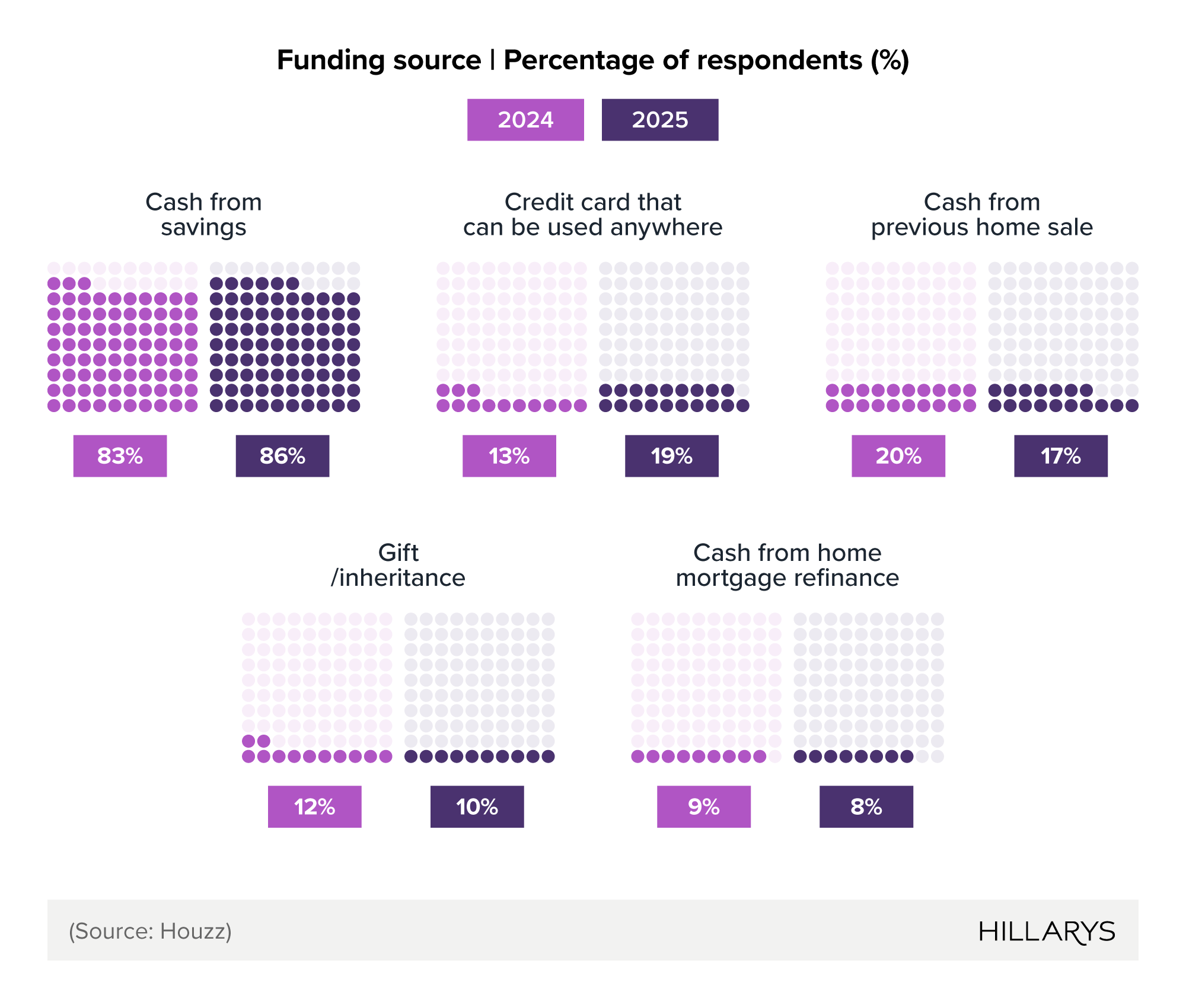
Nearly one in five homeowners (19%) used a general-purpose credit card, an increase of six percentage points from 13% in 2024. Around 17% used cash from a previous home sale, while 10% relied on a gift or inheritance. Mortgage refinancing was the least common funding source listed, used by 8% of homeowners.
There are several options available when it comes to funding a house renovation project. You could use cash, remortgage to release funds, take out a secured homeowner loan or use a credit card. It may be worth seeking financial advice before deciding to help find the best solution that is right for you.
When hiring home renovation experts, electricians (56%) and plumbers (54%) were the professionals most commonly used by UK renovators in 2025.
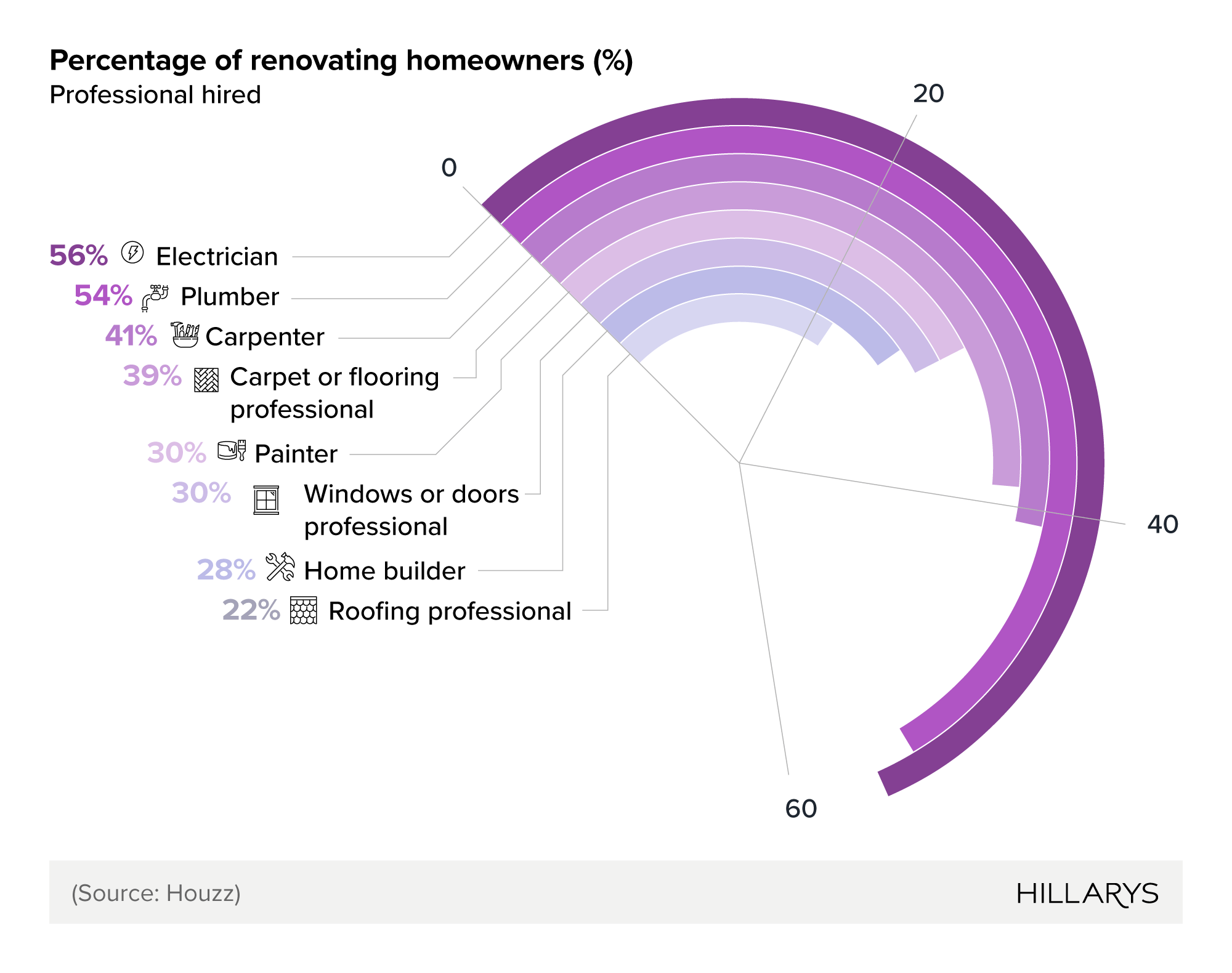
Around two in five homeowners also brought in a carpenter (41%) or carpet and flooring professional (39%). Three in 10 hired a painter or windows and doors professional (30% each), while more than one in four used a home builder (28%). Roofing professionals were hired by just over one in five renovators (22%).
Garden renovation costs in the UK in 2026 typically range from £5,000 to £10,000 for a complete makeover, although the final price will depend on the size of the garden, the materials used and the scale of the work.
Hiring a garden designer can add between £30 and £150 per square metre, or around 5% to 15% of the total project cost. Hard landscaping features, such as paving and decking, often account for a significant share of the overall budget.
Homeowners looking to reduce their garden renovation costs can consider simpler improvements, such as turfing and planting, which can still make a noticeable difference without requiring a complete redesign.
Almost three-quarters of homeowners (72%) changed the layout of their kitchen during renovation work, making this the most common major alteration. This was followed by upgrades to home systems, such as plumbing or electrics, which were carried out by three in five homeowners (60%).
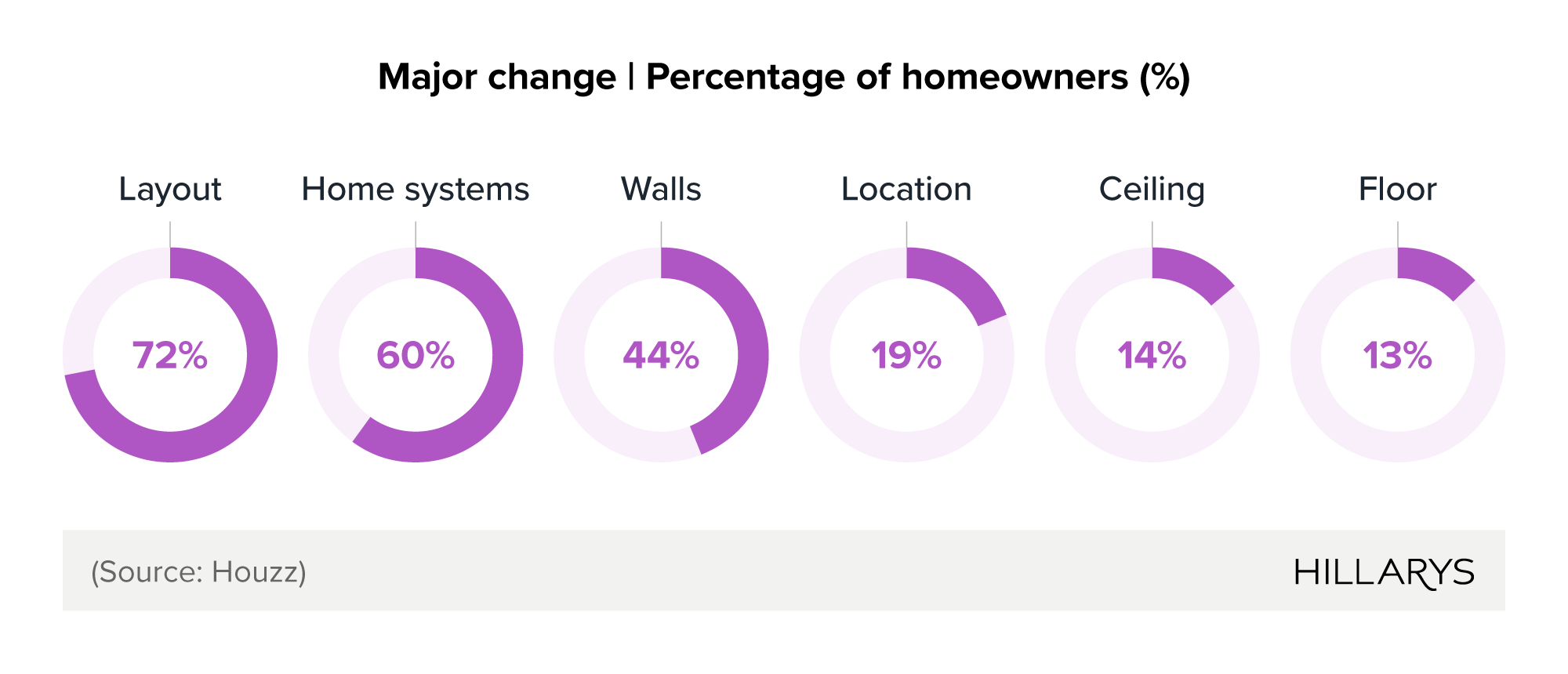
Changes to walls were also relatively common, affecting just over two in five renovated kitchens (44%). Larger structural alterations were less frequent, with around one in five homeowners relocating the kitchen (19%). Roughly one in seven changed the ceiling (14%), and a similar proportion altered the floor (13%).
While layout and system upgrades were among the most common changes made, homeowners were prompted to renovate their kitchens for a range of practical and personal reasons.
Kitchen deterioration was the leading renovation trigger, cited by just over a third of homeowners (37%). Personalising a recently purchased home ranked next at 32%, while 29% said they finally had the financial means to complete the work.
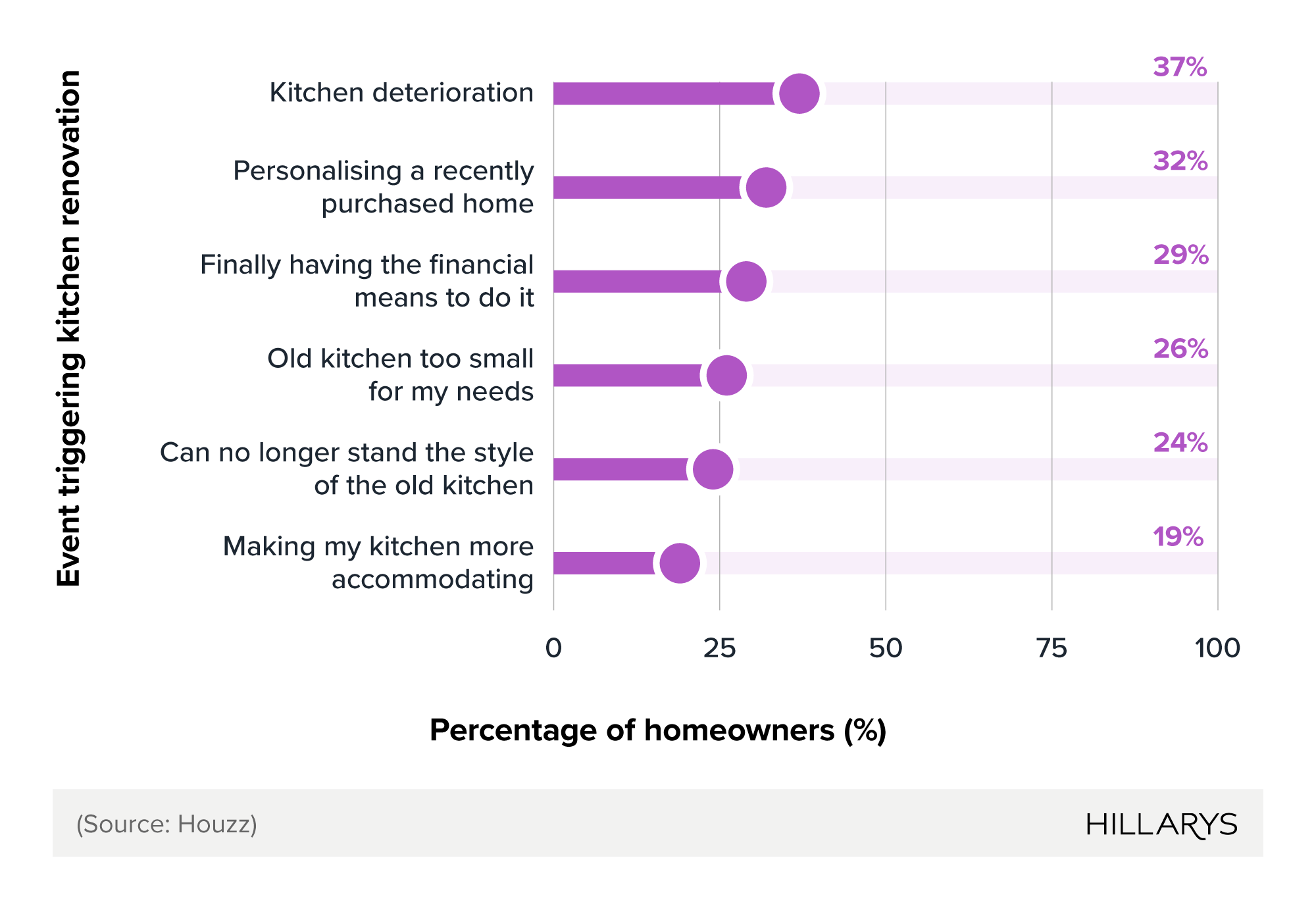
Around one-quarter renovated because their old kitchen was too small (26%) or they no longer liked its style (24%), suggesting practical needs were slightly more influential than appearance alone.
Once homeowners decide to renovate, sustainability also plays a role in the features they choose. Energy-saving lighting and appliances were particularly popular additions in renovated kitchens.
Nearly three-quarters of homeowners installed LED light bulbs (71%), making them the most popular sustainable feature. Just over half chose energy-efficient appliances (52%), while more than two in five opted for a timeless kitchen design (44%).
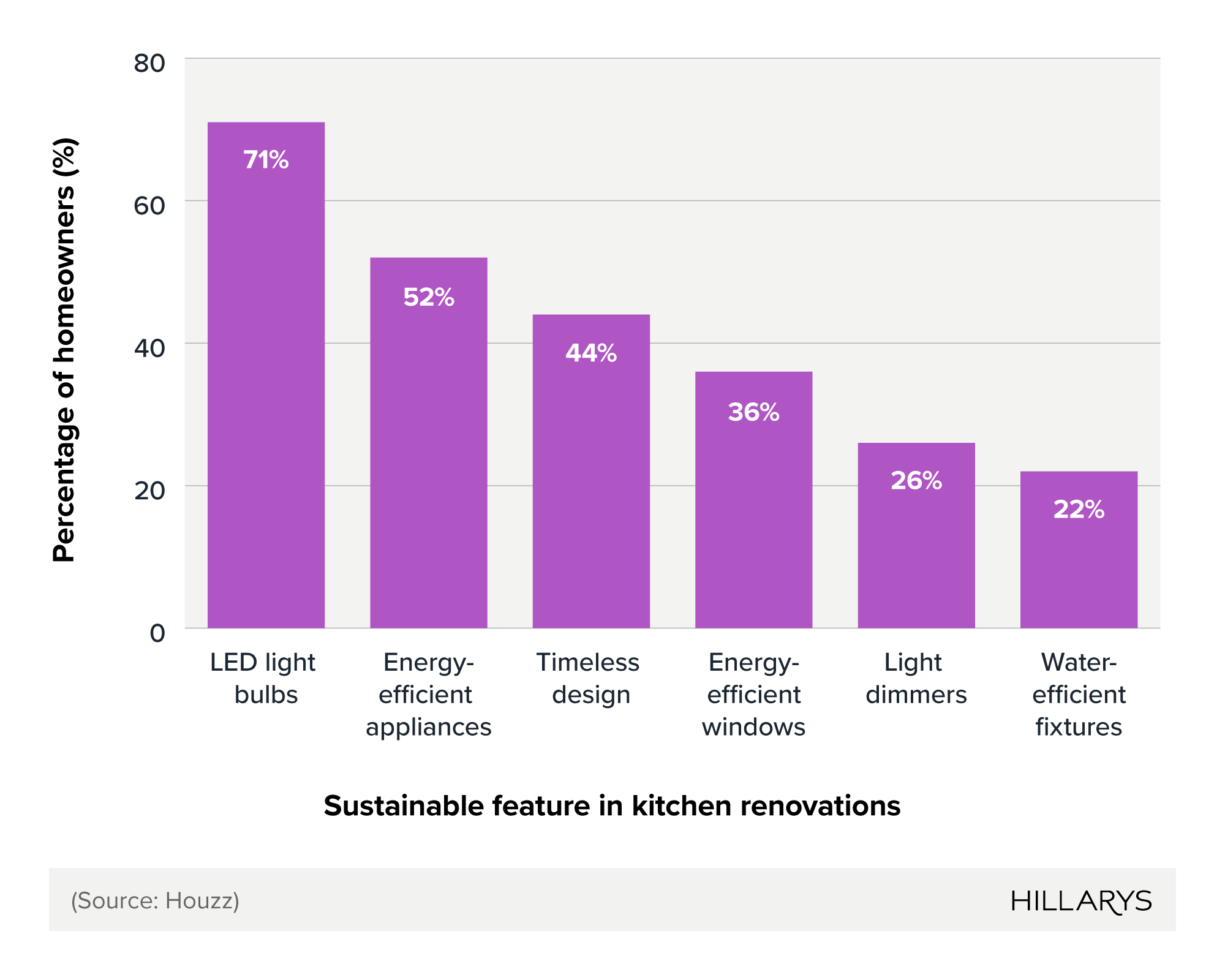
Energy-efficient windows were selected by just over a third of homeowners (36%). Light dimmers (26%) and water-efficient fixtures (22%) were less common, although both were still included by around one-quarter.
"If you’re one of the 10% of people who dislike their kitchen because it is poorly lit, then you might like to consider investing in some new blinds, curtains, or shutters for your kitchen windows. Blinds, especially those with adjustable slats (such as Venetian blinds), allow you to control the amount of natural light in your kitchen, reduce glare, and diffuse harsh sunlight. This will help with temperature control and produce a more relaxing environment for you to cook, eat dinner, or whatever else you like to do in your kitchen."
Sustainability is not the only factor shaping kitchen renovations, as the amount of available space also influences the finished design.
A quarter of renovated kitchens measured between 20 and 29.99 square metres, making this the most common size range. One in five measured between 10 and 14.99 square metres (20%), while 16% were between 15 and 19.99 square metres.
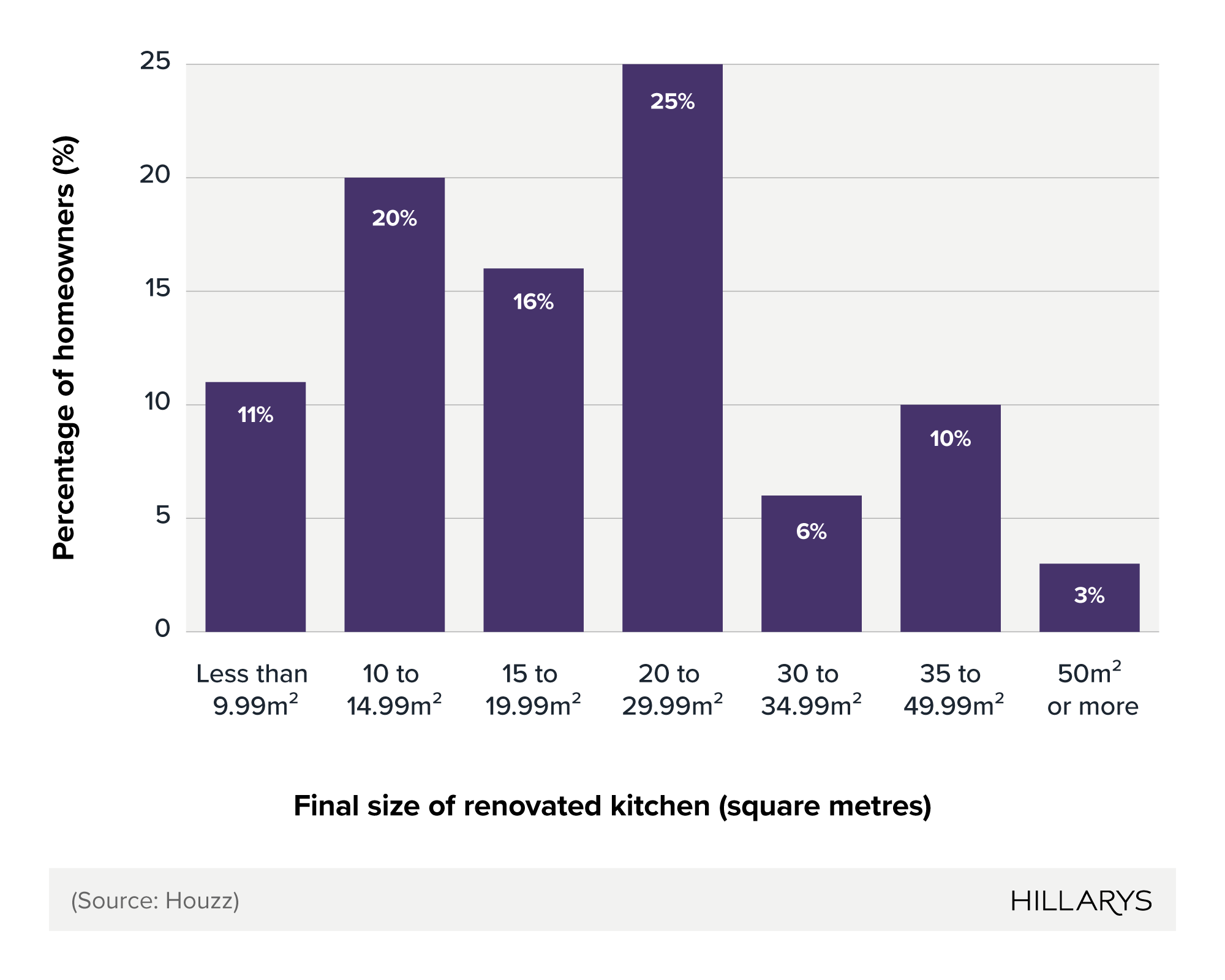
Larger kitchens were less common. One in 10 measured between 35 and 49.99 square metres (10%), and only 3% were 50 square metres or more.
Looking at the design choices made within renovated kitchens, cabinetry colour was another important consideration.
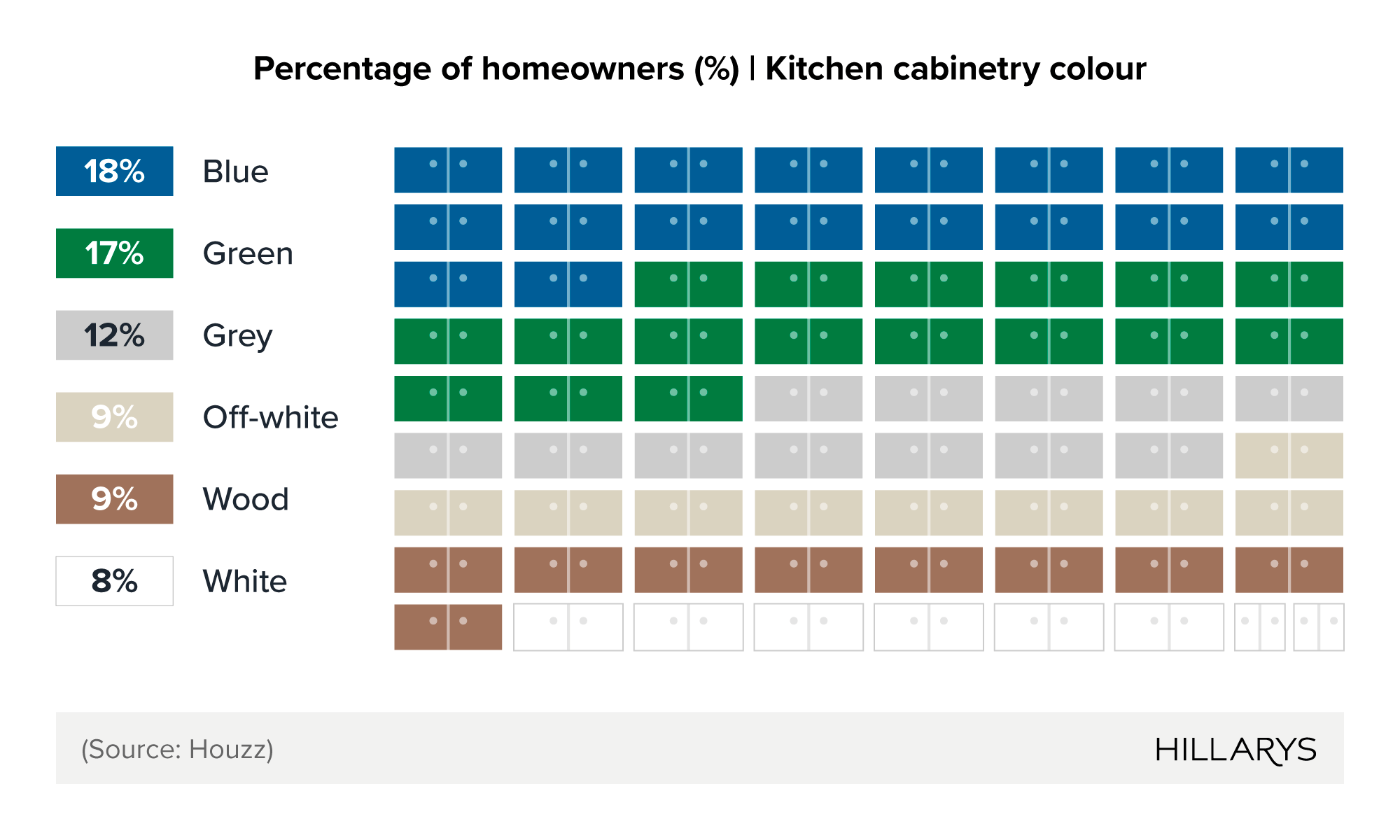
Blue was the most popular choice in 2026, selected by almost one in five homeowners (18%). Green ranked close behind, chosen by around one in six (17%), suggesting many homeowners moved beyond neutral decoration when updating their kitchens.
Around one in eight selected grey (12%), while roughly one in 10 chose off-white or wood (9% each). White was the least popular colour listed, at 8%.
Did you know?
According to Pinterest’s 2025 Trends Report, searches for the colour ‘cherry red’ more than tripled (+235%) in January, making it one of the most popular. For more information and practical tips, check out our guide on how to use 2025’s trending colours in your home.
A typical bathroom renovation takes around three to five weeks on site. More involved projects can take five to seven weeks or longer, particularly when changing the layout, carrying out structural work, moving fixtures or creating an entirely new bathroom.
Despite the time and planning involved, bathrooms were among the most commonly renovated interior rooms in 2025, updated by just over a quarter of homeowners (27%). This was the same proportion recorded for kitchens and bedrooms.
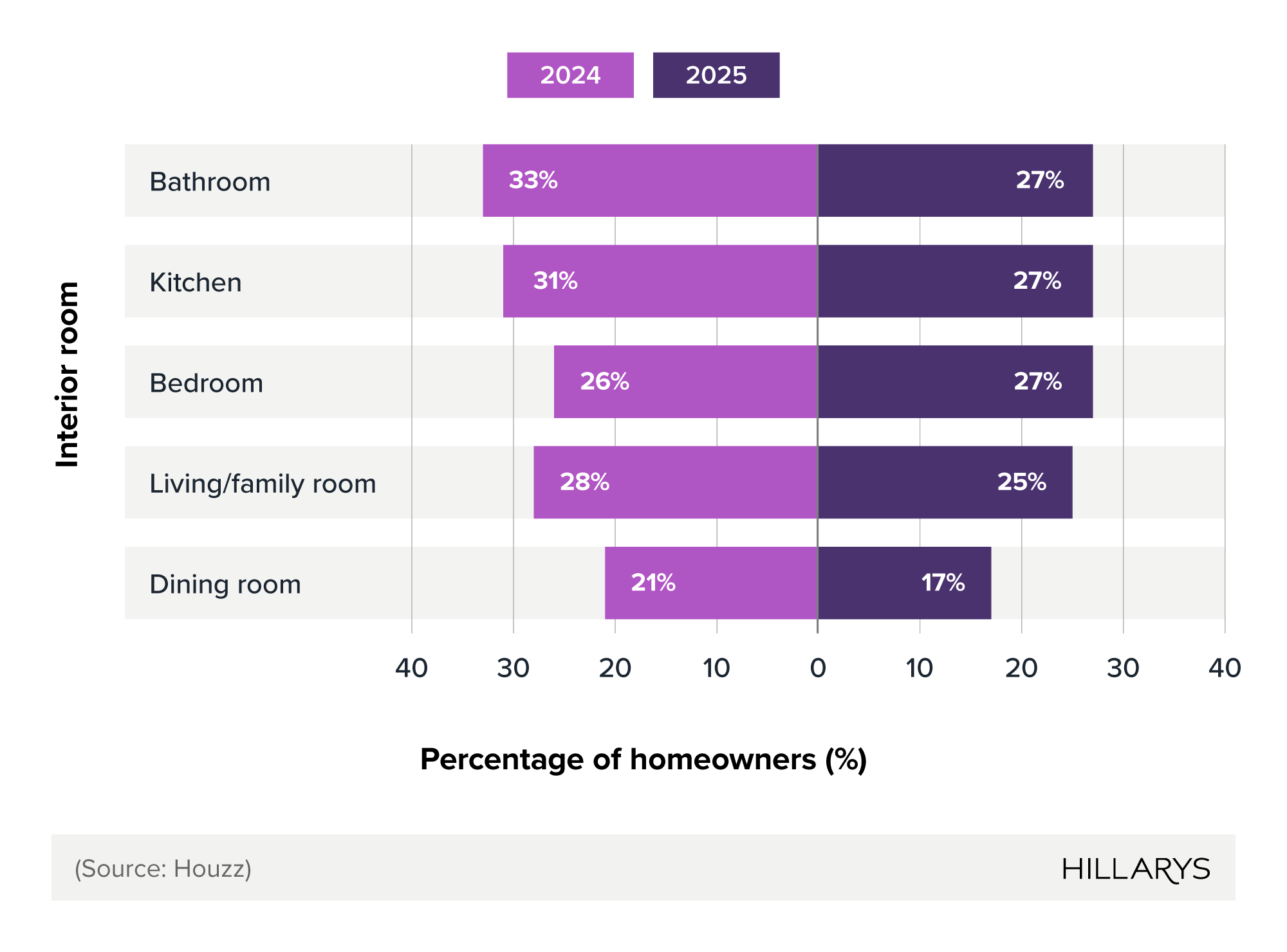
Bathroom renovations fell by six percentage points from 33% in 2024, the largest decline among the rooms listed. Kitchen renovations also decreased, from 31% to 27%, while living and family room projects dropped from 28% to one-quarter (25%). Bedrooms were the only category to increase, rising slightly from 26% to 27%.
Looking more closely at renovation rates by age group, bathroom projects were equally common among Millennials and Gen X, with 29% of each group deciding to remodel. The figure was slightly lower among Baby Boomers, at just over one-quarter (26%).
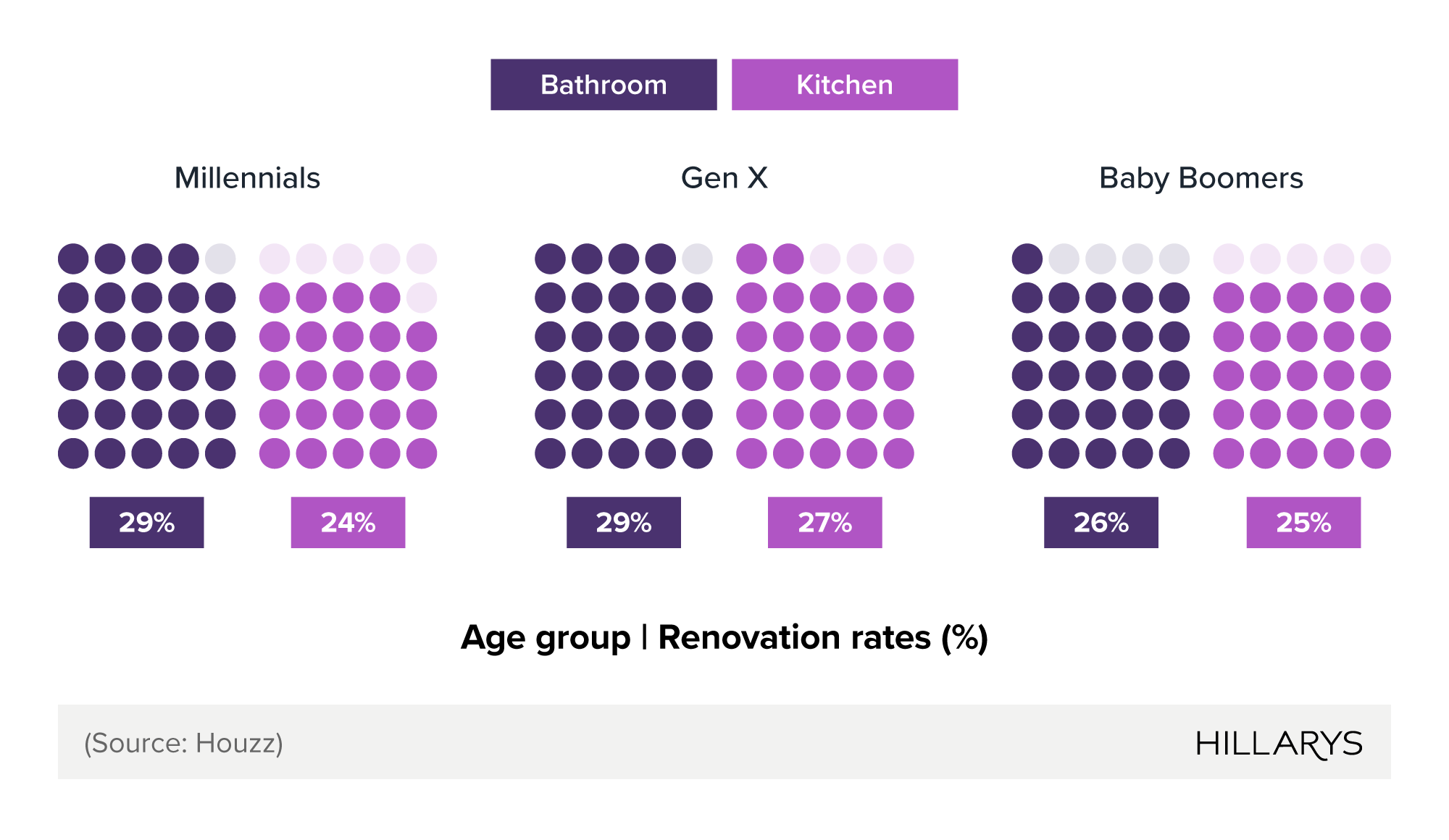
For kitchen renovations, Gen X recorded the highest share at 27%, compared with one-quarter of Baby Boomers (25%) and just under one-quarter of Millennials (24%). The differences between age groups were relatively small, remaining within five percentage points for both room types.
Häfele’s 2026 Home for Living Report reveals that the bedroom is a multifunctional space for many UK homeowners.
Almost half (47%) of those surveyed use their bedroom for relaxing, making this the leading response. More than two-fifths use the bedroom to get ready (43%) and/or store clothes (41%).
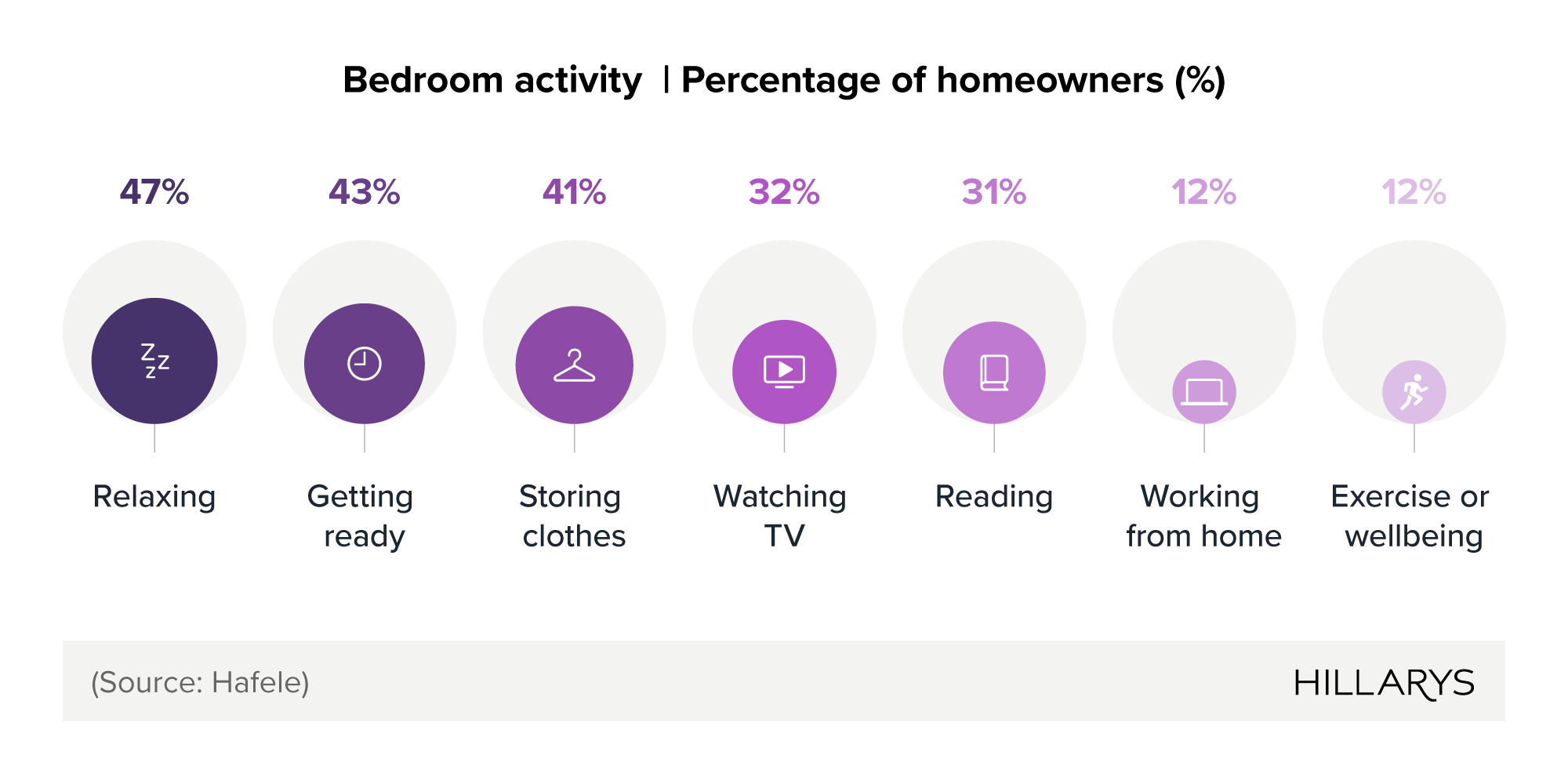
Around a third of respondents use their bedroom for watching TV (32%) or reading (31%). Around one in eight also use the space for working from home or exercise and wellbeing activities (12% each).
| Most wanted bedroom feature | Percentage of respondents (%) |
|---|---|
| En suite | 41% |
| Integrated wardrobe lighting | 37% |
| Dressing area | 37% |
| Smart lighting | 35% |
| Soundproofing | 35% |
| Sliding wardrobe doors | 33% |
| Changeable lighting | 33% |
Source: Information from Häfele’s report Homes for Living 2026, p. 51
When asked what bedroom features would most likely improve their sleep quality, more than two-fifths (41%) of those questioned by Häfele said they would like an en suite – the most popular answer.
More than a third wanted integrated wardrobe lighting or a dressing area (37% each), while 35% selected smart lighting or soundproofing.
Almost a third (31%) of UK homeowners currently use the space under their stairs as a cupboard for coats, with a similar proportion (32%) saying they would like to use it for this purpose.
| Use | Percentage of respondents who currently use this space (%) | Percentage of respondents who currently would like to use this space (%) |
|---|---|---|
| Pull-out shoe drawers and/or handbag storage | 22% | 34% |
| A cupboard for coats | 31% | 32% |
| A utility cupboard, e.g. with a washing machine and/or dryer | 22% | 30% |
| Storage for equipment for non-sports-related hobbies | 25% | 29% |
| A downstairs toilet | 23% | 28% |
| A home library or reading nook | 16% | 27% |
| A home office or homework station | 17% | 26% |
| Storage for gym or exercise equipment | 18% | 25% |
| Storage for toys | 19% | 25% |
| A bed space for pets | 18% | 25% |
| A play den for children | 13% | 25% |
| A focal or statement area | 15% | 25% |
| A wine or drinks cellar | 17% | 24% |
| A home bar | 13% | 24% |
Source: Information from Häfele’s report Homes for Living 2026, p. 55
Pull-out shoe drawers and handbag storage recorded the greatest difference between current and desired use. Just over a fifth (22%) currently use the space this way, compared with around a third (34%) who would like to. Demand was also higher for utility cupboards, rising from 22% to 30%, and home libraries or reading nooks, increasing from 16% to 27%.
Häfele’s research also highlights the practical barriers preventing homeowners from making better use of their understairs space.
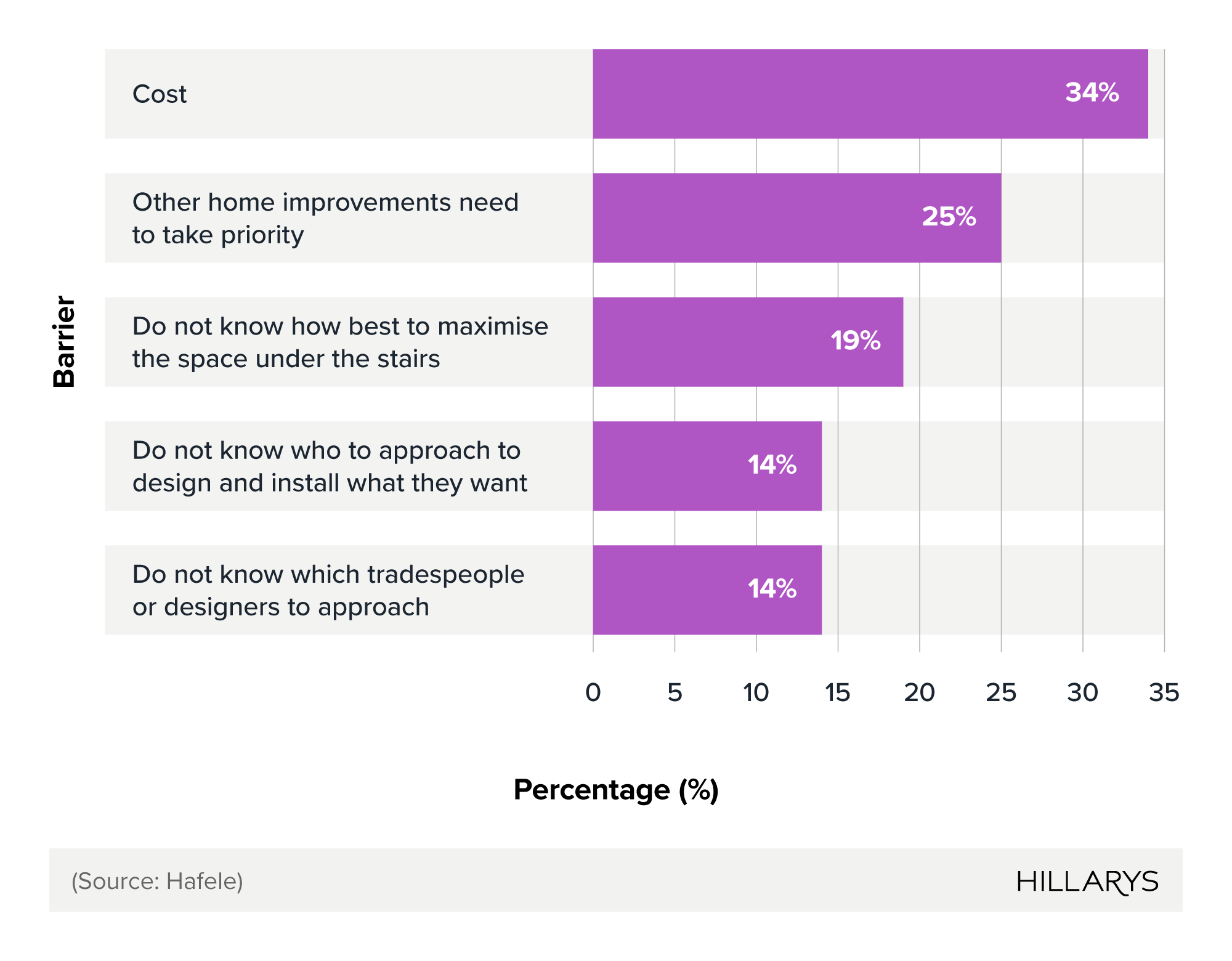
In 2026, 34% of respondents cited cost as the main obstacle, and 25% said other home improvements needed to take priority. Almost one in five (19%) were unsure how best to maximise the space, and 14% did not know who to approach for the design and installation or which tradespeople or designers to contact.
The UK Houzz & Home Renovation Trends Report reveals that more than two-thirds (68%) of homeowners who renovated their property in 2024 were either married/in a civil union with a spouse present in the home.
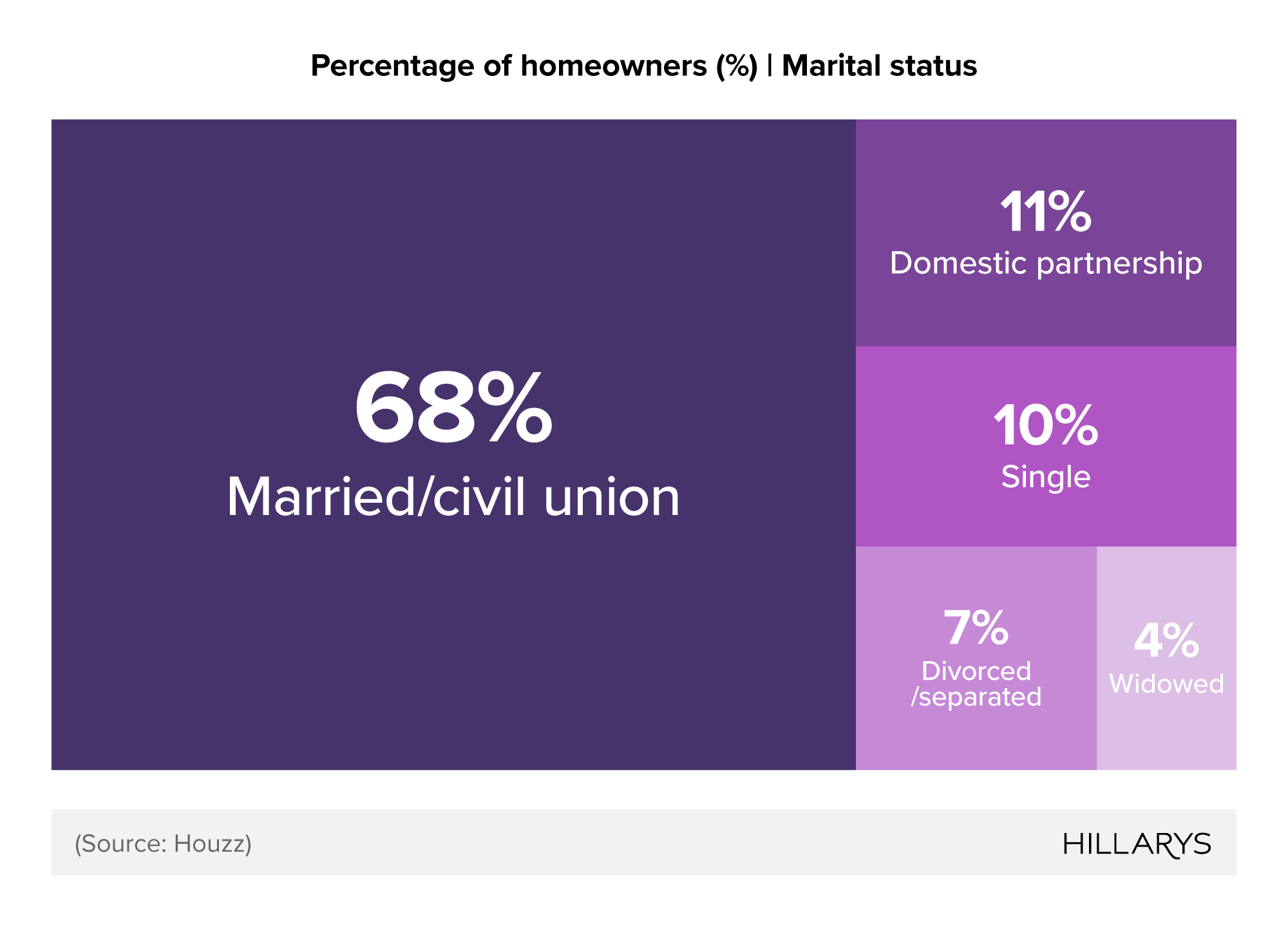
Around one in nine (11%) UK home renovators surveyed by Houzz in 2025 were living with a significant other or in a domestic partnership, followed by one in 10 who were single. A further 7% were divorced or separated, while 4% were widowed.
Just under a third (33%) of those who renovated a UK property in 2025 held a bachelor’s degree, with a similar proportion (32%) having some university education or less. This means, collectively, almost two-thirds (65%) of the UK home renovation population had some form of undergraduate qualification.
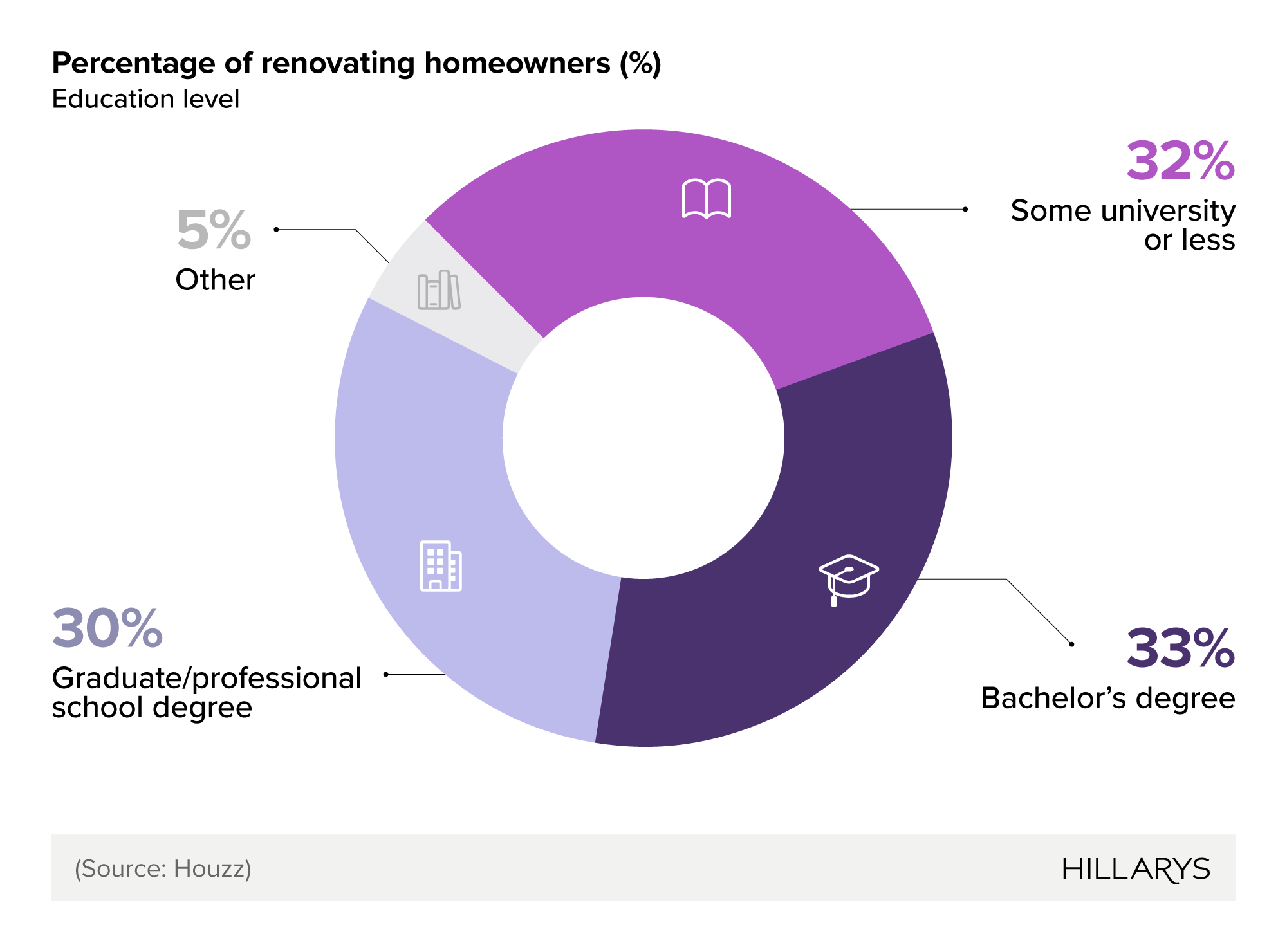
Three in 10 renovators held a graduate or professional school degree, while the remaining 5% reported another level of education.
Almost a third (31%) of UK home renovators questioned by Houzz in 2025 were from households with an annual income of less than £50,000. A larger proportion, two in five (40%), came from those with combined earnings of £50,000–£99,999.
| Income group | Percentage of respondents (%) |
|---|---|
| Less than £50,000 | 31% |
| £50,000 - £99,999 | 40% |
| £100,000 or more | 30% |
Source: Information from Houzz’s report Houzz & Home: Study Renovation Trends, p. 23
This means around three in 10 (30%) people who refurbished their home in 2025 had a household income of £100,000 a year or more.
This suggests that those with middle-income were slightly more likely to renovate their property in 2025, while the proportions from the lowest and highest income groups were almost identical.
According to UK home renovation statistics from Houzz, just under a fifth (19%) of those who undertook a property refurbishment project in 2025 did so for a house built between 1961–1980. This made them the most popular property age for renovation projects in the UK for that year.
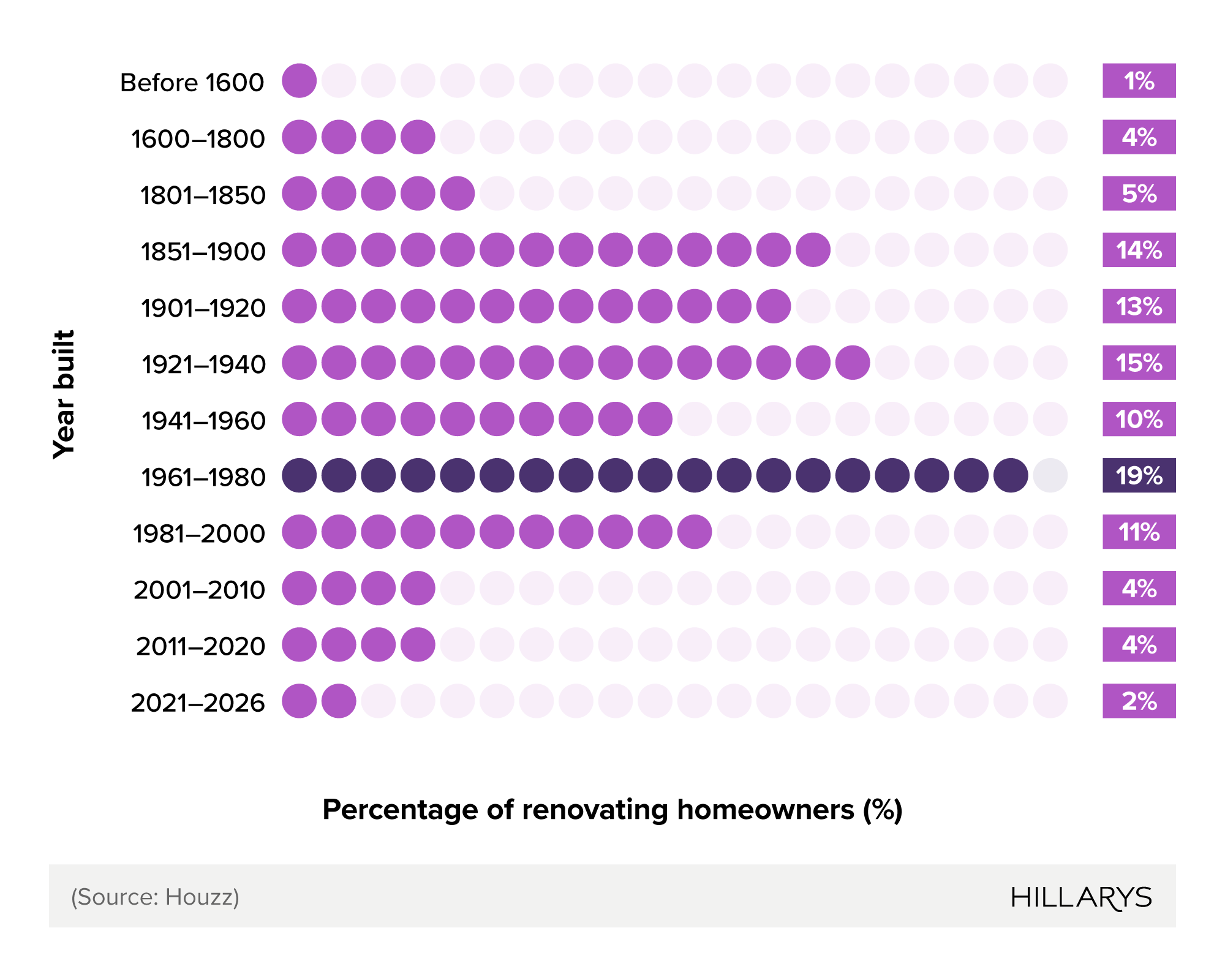
This was followed by around one in seven properties built between 1921 and 1940 (15%) and a similar proportion constructed between 1851 and 1900 (14%).
Incidentally, homes built before 1600 were the least represented property age in the Houzz survey, occupied by just 1% of home renovation projects completed in 2025.
More than two-fifths (41%) of UK home renovation projects from 2025 were for detached houses – the most common property type to feature for that year.
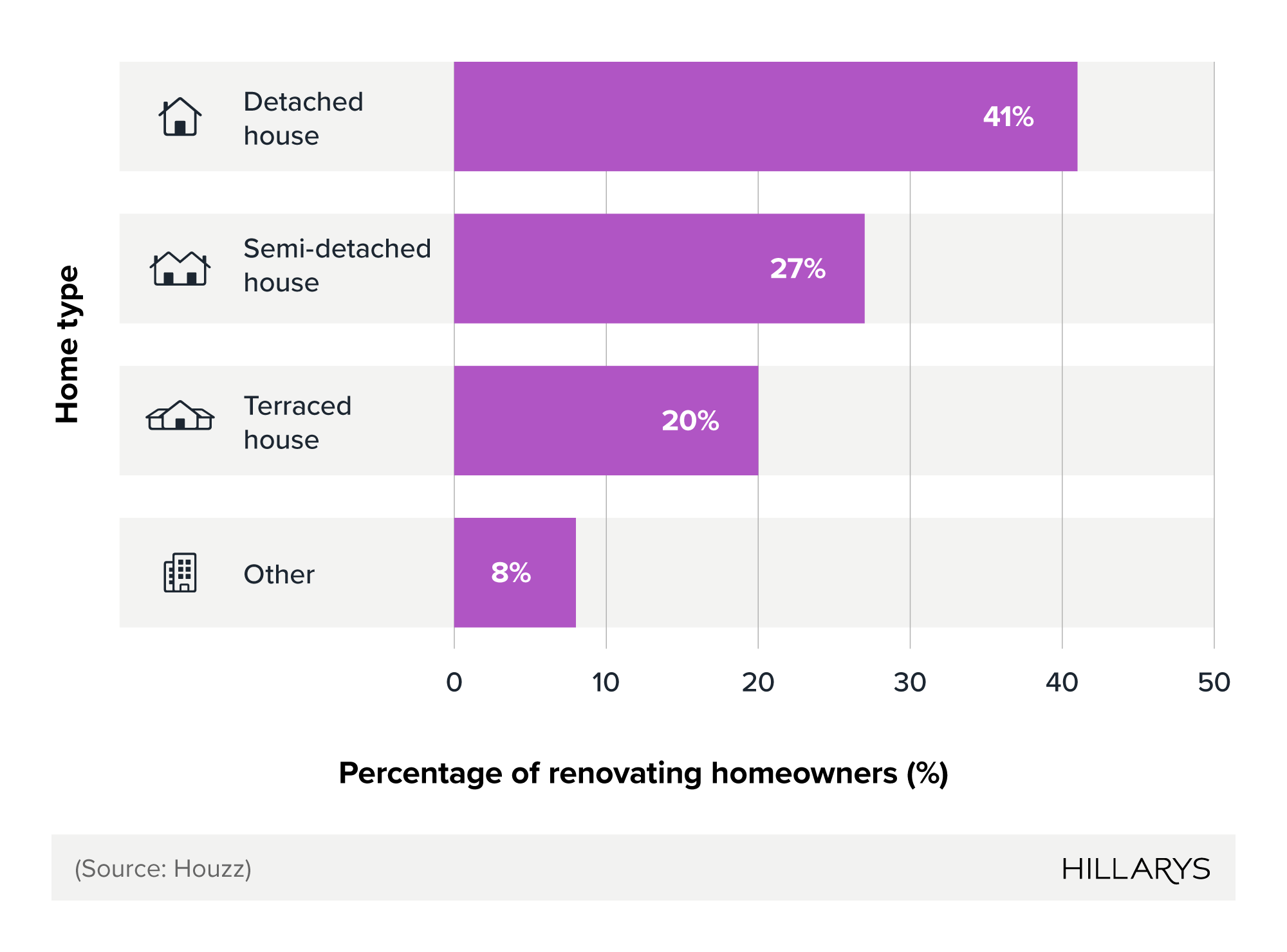
This was preceded by semi-detached houses, which occupied just over a quarter (27%), and terraced houses, which represented one in five (20%) of UK house refurbishment projects in 2025. A further 8% involved other property types.
Of those surveyed by Houzz in 2025, more than half (55%) of UK home renovators did so for properties worth £500,000 or more.
| Property value | Percentage of respondents (%) |
|---|---|
| Less than £300,000 | 15% |
| £300,000 - £499,999 | 30% |
| £500,000 - £999,999 | 41% |
| £1,000,000 | 14% |
Source: Information from Houzz’s report Houzz & Home: Study Renovation Trends, p. 24
This was followed by three in 10 (30%) who renovated a house valued between £300,000 and £499,999 and 15% who opted to improve properties worth less than £300,000.
When it comes to planning a house renovation, there are several steps you should follow to ensure a successful outcome.
Every property renovation project is different, but most should consider the following at some stage:
A home improvement loan is an unsecured personal loan used to help fund improvements to a property, such as an extension, a new kitchen, or interior decorating.
To get a home improvement loan, you’ll have to apply for one with a lender. For this, you’ll need identity documents, such as proof of income, after which your application will be reviewed by the lender alongside your credit history. You should expect an outcome within five working days, but some lenders may let you know instantly.
Once approved, your home improvement loan should arrive in your account within a few working days.
Home improvement loans can vary in length from one to 10 years, depending on how much you are borrowing.
According to Checkatrade, renovating a house could add between 3% and 5% to the property’s value, depending on your buyer’s preference and market dynamics at the time of selling.
According to Nationwide’s home improvement loan calculator, a £7,750 loan repaid over 60 months has a representative fixed APR of 5.9%.
A full-house renovation will typically take around two to four months to complete. However, the timeline can extend if the project involves several structural alterations or more complex building work.
According to the Federation of Master Builders’ 2025 State of Trade survey, 49% of small and medium-sized building firms experienced project delays due to shortages of skilled tradespeople, while 22% reported cancellations. With delays this common, it’s worth booking contractors early, building some flexibility into your schedule and allowing extra time in case plans change.
Most homeowners fund renovations using cash savings. In 2025, this option was used by almost nine in 10 Gen X homeowners (89%) and more than four in five Millennials (86%) and Baby Boomers (83%).
According to Checkatrade, the average cost of renovating a three-bedroom house in the UK is around £76,690 in 2026.
There is no single average house refurbishment cost, as the final amount will depend on the property’s size, condition and location, as well as the extent of the work required.
As a general guide, a full house refurbishment is typically estimated to cost between 15% and 30% of the property’s value after renovation, with extensive projects likely to fall towards the higher end of this range.